Showing posts with label Bud Selig. Show all posts

Tuesday, September 16, 2008

How the Astros got screwed

ON BASEBALL

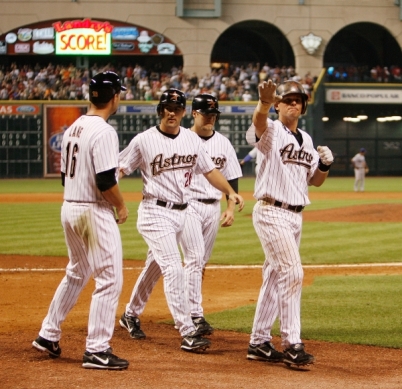
Welcome to the life of a Houston Astro.

You win six straight games in September, are feeling good about yourself for the first time, really, all season. And then this happens:

Your family, your home, your neighborhood are attacked by Hurricane Ike, a storm that doesn't discriminate while causing mass chaos to everything in its way. All of a sudden, you're not just worried about catching the Brewers in the Wild Card race. You've got much more important issues to think about.

Of course, it's a bummer that the first two games of your crucial home series with the Cubs are Iked out — considering the momentum you're carrying on the field — but hey, that's life on the Gulf Coast. You figure you'll take the weekend to take care of non-baseball issues and then get back to the grind.

That's the case until Sunday, when suddenly you learn the news: You're making up two of the series' games the next two days. Great, you think. Back to baseball. Getting back on the field is always a nice distraction. But then you're told to prepare for a flight to Milwaukee.

"Milwaukee????" you think, "I thought this was a home series." You realize that you still can't play in Houston because of conditions, but why go all the way to Milwaukee when you could play two in Arlington (where the Rangers don't start a home series until Monday night); Atlanta; or, worst-case scenario, St. Louis? At least you wouldn't feel the Sears Tower looking down on you.

Instead, you're to hop on a plane for a city that lies less than an hour from Wrigley Field.

You're a professional, so you do what you're told. But your head's not into it. Your situation at home post-hurricane still isn't settled. And now you're embarking on a road trip that won't have you home for over a week. You arrive at Miller Park in time to get dressed and prepare for the game. Meanwhile, the Cubs could have carpooled up I-94 W. In no way are you ready for what's basically become a road game; that's not good, considering the importance of the contest.

Add to that the fact that you get to face Cubs ace Carlos Zambrano. Sure, he's coming off an injury, but on this night he has his best stuff. It's not fair. Zambrano no-hits you, sending the Miller Park crowd into a frenzy.

The only good news of a hectic day? The Phillies swept the Brewers, so you didn't lose any ground in the Wild Card race.

Instead of resting, however, you must wake up the next morning for a day game back at the Cubs' second home field. Again not in your best form, you manage just a single hit in a 6-1 loss. The two L's mark the first time in baseball's long history that a team has managed just a single hit in two games. You hate the statistic, but know there should be an asterisk next to it.

You lose a half game to the Phillies and Brewers, who got to rest for a day. But you don't get that opportunity. Instead, you hop a plane for the nice, short flight down to South Beach for a three-game set with the Marlins. It's always nice to zig-zag north and south when flying.

After another loss Tuesday night, you're back to three games out in the Wild Card. There remain just 12 games. Your six-game winning spree has dissolved into a dismal three-game losing slide. All the momentum and good feelings are gone.

Yes, you're a professional, so you move on, prepare for the next game. That's all you can do. But you wonder: Did Bud Selig, the baseball commissioner/Milwaukee Lover, do all he could to accommodate our best interests? Did he look into all the options?

Then you ask yourself the ultimate question: Did we get screwed?

Well, I've got the answer for your, dear Houston Astro.

Yes, you got screwed.

Thursday, March 27, 2008

Baseball already??

ON BASEBALL

I heard a rumor Tuesday morning.

Sitting at the dining room table, eating some blue corn chips, I opened the sports section to read that it was "Opening Day." Wait ... Opening Day? On the 25th of March?

I continued reading to find out that not only was it opening day, but it was taking place across the world in Japan, and it featured just two major league teams — Boston and Oakland.

The next day, while browsing the paper and eating some Raisin Bran, there was the box score from the Red Sox' win over Oakland — right next to a whole bunch of exhibition linescores. I encountered the same confusion when I opened up today's paper.

And now — another rumor — Boston and Oakland will go back to playing exhibition games with the rest of the teams?

Listen, I love baseball as much as any other 1980s baby. I grew up listening to every Tigers game on the radio — even though the team was terrible. I don't go a year without making it to a few Tigers game even though they're tearing down the stadium they should still occupy.

Without baseball season, I don't know what I'd do all summer.

But baseball in March makes as much sense as sailing in January. Yeah, not a good idea.

Not only did no one care about Opening Day, which was on T.V. at 6 in the morning here, but the actual first game of the season in the U.S. is just that — a single game. Atlanta will play Washington Sunday night in an ESPN national telecast. On the same day, the A's and Red Sox — who are both 1-1 — will play their final exhibition games?

My head is spinning.

Finally, the legitimate Opening Day — as in, where almost every team plays in ballparks across the country — will take place next Monday (March 31). Only problem is, not only will it be anticlimactic, well, the climates in certain places might just be too chilly/snowy to handle baseball.

Detroit. Chicago. Philadelphia. Cleveland. The list goes on...

Does not anyone remember what happened in Cleveland a year ago? If my memory serves me right, the Indians and Mariners were doing snow angels on Jacobs Field (which, apparently — after a scan of the Web site — is now Progressive Field). And then they played a baseball game in Milwaukee! Yet, Bud Selig and his cohorts has this idea that we should start baseball season in March. And if sports weren't such a huge part of my life, I wouldn't pay one bit of attention to the first week of baseball season.

That's because the beginning of baseball season is trying to steal some magic from the end of March Madness. On Final Four Saturday April 5, there will be a plethora of baseball games. Ditto on championship-game Monday.

Now, baseball fans might say that the end of college basketball season is infringing on the beginning of their season. After all, it's "March Madness," not "March-April Madness," right?

But c'mon, people. Isn't baseball season long enough as is? Just this past fall, the World Series was pushed back to reach November. Including spring training, that's eight and a half months of baseball. I love the game — really do — but even that's overkill.

This is an easy solution: Start baseball season the Tuesday after the national title game. This year, that would mean April 8. It would also mean less of a chance of a snow-out, which I can all but guarantee will happen in some northern city next Monday.

Of course, my proposal has no chance of happening. That was so, like, 10 years ago.

Today's sports world is all about globalization and primetime audiences. That means flying the Red Sox and A's 15 to 20 hours across the world for a period of a few days. I don't blame Josh Beckett one bit for not wanting to go, regardless of his injury. I wouldn't.

I wouldn't have had as big of a problem with the teams flying to Japan during the middle of March for a week of exhibition games. That way, the Japanese fans still would get to see some Major League Baseball. They would still get to watch their hero Daisuke Matsuzaka in person. But it wouldn't take away from Opening Day back here.

Now, I couldn't care less about Opening Day I, Opening Day II or Opening Day III. They're all too early for me. My main focus will be on college hoops until "One Shining Moment" a week from Monday.

Even if my Tigers are 6-0 at that point.

Wednesday, December 19, 2007

What a mess

ON BASEBALL

Does anyone even care anymore?

Do modern-day records even have any legitimacy anymore?

Yes, it's gotten to this point.

If it weren't for the Red Sox winning its first World Series in 96 years and the White Sox its first in 98 years, wiping out the past 10 years of baseball wouldn't be a bad idea.

Seriously.

Here's how bad things have gotten for MLB commissioner Bud Selig: Arguably the game's best hitter of all time, Barry Bonds, is generally assumed to have taken steroids and was recently indicted for obstruction of justice and perjury.

And arguably the game's best pitcher, Roger Clemens, looks just as dirty. According to last week's Mitchell report, Clemens had his trainer inject him with Winstrol.

While I'm not jumping to any conclusions, Clemens has done nothing in the week since the report came out to make himself appear innocent. Tuesday, he issued a statement through his lawyer believable as Bonds' countless "I am innocent" statements.

If Clemens were innocent, he would have immediately called a press conference after learning of his name's inclusion in the report. He would have stood up in front of dozens of cameras and told the truth. But, no, instead he said in his heartfelt statement that he will speak at the "appropriate time."

When will that be? Once, of course, Clemens' legal team figures out what can happen to him because of the report's findings.

Whatever.

No matter what scheme Clemens' team puts together, I'm not believing him. He had a chance last week to refute the report. Statements through lawyers don't count. Call me Mike Nifong, but Clemens is guilty.

Which makes him no better than Bonds.

So following that thinking, here we stand in 2007 — with two of the game's greats under a nebulous anvil, not to mention several other high-profile players, such as Andy Pettite who admitted to using HGH twice.

Once, twice, 18 times, it ain't right, Andy. Even if you're supposedly using it to heal from an injury. Yet Pettite's apology, if you can call it that, read (AP), "If what I did was an error in judgment on my part, I apologize. I accept responsibility for those two days."

"If," Andy? C'mon. Illegally obtaining HGH from a trainer isn't exactly a good deed. Who are you trying to kid?

Not only are the guilty players unwilling to stand up for their actions and admit they were 100 percent wrong, Selig thinks he tried everything to keep this from happening.

You serious, Bud?

Let's see. Despite that home-run jacking Summer of '98, when Big Mac launched 70 and Slammin' Sammy added 66 — after hitting 36 the previous season. Despite Bonds' jump from 49 dingers in 2000 to 73 to '01. Despite increased long balls from Miami to Seattle, Selig refused to implement a steroids policy until September of 2002.

And despite revisions before the '05 and '06 seasons, it's still as weak my non-existent triceps (see my previous column, "Baseball needs to follow IOC's lead").

Yet Selig, like Bonds and Clemens, refuses to apologize for what the nation's former pastime became.

In an AP story, Selig said: "I'm proud of where we are. We have the toughest testing program in American sports. We banned amphetamines, which were a problem in our sport for seven or eight decades."

Selig went on to say that minor league drug testing has been in place for eight years now

Yay! Good to know we've been catching the guys who we don't care about anyway. It's not the younger players — the minor league players — who have done the most juicing, Bud. It's the older guys who need that boost to make it through the long season.

And as far as baseball having the "toughest testing program in American sports," who cares?

I hate when people defend themselves through comparative means. Sure, baseball has a stricter policy than the NBA. But I'm sure if David Stern smelled a rising HGH addiction among his players, he'd institute harsh penalties. Heck, Stern regularly suspends players for flagrant fouls even when they appear to be going for the ball.

But back to that other sport.

This isn't going away. Not this year. Not in five years. Maybe not in 10 years. The debate will be heated when Bonds and Clemens become eligible for the Hall of Fame. And when, and if, A-Rod approaches Bonds' home-run record.

I've already suggested a lifelong ban for MLB players who are caught taking steroids or HGH. It won't happen. Players, unfortunately, won't be scared to use the next undetectable product on the market. They won't be afraid of getting caught.

At first I thought the Mitchell report was a good thing, which helped to shed light on baseball's Big Problem and submit suggestions for the future.

Now, I don't know. Now, I don't care.

Being naive is no longer an option. The truth is too transparent.

Baseball, its players, its records and it holy shrine in Cooperstown are all tainted.

And will likely continue to be tainted.

Friday, December 14, 2007

Baseball needs to follow IOC's lead

ON BASEBALL

While the "Mitchell Report" received several consecutive hours of coverage on ESPN — and many other networks, both sports and news — throughout Thursday afternoon and well into the evening, the saddest story of this depressing last week in sports (think: Michael Vick, Bobby Petrino, etc.) garnered close to no national attention.

Marion Jones
, one-time superstar, one-time role model for female athletes, one-time holder of five medals, was forced to return those three gold and two bronze medals and was banned from even attending the 2008 Olympics in Beijing and possibly future Summer Games.

Jones' results from the 2000 Sydney Olympics — and from any event since then — have been scrapped by the International Olympic Committee as a result of her admitting in October that she began using steroids before the Games. Basically, a young girl in 50 years who examines Olympic records and medalists won't even know Marion Jones existed.

That's the way to punish a drug user.

Seriously.

Major league baseball commissioner Bud Selig would be wise to follow the IOC's example. Not that that's ever going to happen.

The fallout from the Mitchell Report will be minimal. Selig said he might attempt to punish players on a case-by-case basis. He'd be wise to simply let what's happened go and, instead, refocus on creating a much stronger policy for both anabolic steroids and Human Growth Hormone (and any new performance-enhancing drug that hits the market).

The current initial punishment for a player who tests positive is 15 to 25 games. A second violation is 25 to 50 games. A fourth — yes, fourth! — positive test is at least a year's suspension.

Are you kidding me? So a major leaguer could test positive for, let's say, the cream not, once, not twice but three times ... and be suspended for 50 to 75 games.

No wonder some 85-plus players were named in Mitchell's 409-page report. If I wasn't against cheating and I was in the majors and needed a boost to get that next contract, uh, it's a no-brainer. Have a trainer stick a needle in my backside every now and then, and watch my numbers soar.

In one sentence, baseball's "crackdown" on performance-enhancing drugs to this point has been a joke.

While it was nice to clarify that bullies such as Roger Clemens were on 'roids, all the report does is tell us what we already know and make baseball purists cringe even more than they have during this Steroid Era. As ESPN's "legal analysts" made painfully clear about 409 times Thursday, there are no cases against the players. Donald Fehr, the executive president of the Major League Baseball Players Association, won't let any of his players go down — for even a measly 15 games — without a few Mayweather right and left jabs.

Plus, several of the named players are already retired — good time, I guess — and others, specifically Clemens and Barry Bonds, are likely done now as well.

The only major effect the report will have on the players mentioned is when their names come up in the Hall-of-Fame conversation. And won't that be fun?

If Selig, or anyone in baseball, wants to make a real impact here, he needs to implement a lifetime ban from baseball for any first-time offender of the league's policy. As crazy as this sounds, ask Marion Jones. I'm sure she'd agree.

Players need to fear for their careers when they make the choice to do 'roids. Players need to question themselves when they inject HGH, even though there still isn't a reliable test for it (although Selig is in favor of implementing a rather new blood test starting in 2008).

Ultimately, players need to be sent a stern message that if they get caught taking any amount of any banned substance, that's it. They're done. Regardless of their names. Regardless of their accomplishments on the field.

Is this realistic? Of course not. Fehr will not comply. The players will rage against it, which, I reckon, says so much — sadly — about the priorities of today's players.

Selig promised Thursday to unilaterally implement all of Mitchell's suggestions for the future that he could, and work with Fehr on the rest. Here's another suggestion for you, Bud: Rid of your weak, 15-game suspensions.

Unless you closely follow the IOC's lead on punishment, the rest of the changes you make won't be very effective.

Saturday, August 18, 2007

Saturday, 8/18/07's main point: Sympathizing with Selig

ON BASEBALL

Some things in life are easy.

Sleeping, eating and reading the sports section top the list for me. Another thing that's been easy to do the past few years is criticize Major League Baseball commissioner Bud Selig.

He ignored the evidence of steroids during the 1998 Home Run Chase and while Barry Bonds was at his peak. He took too long to implement a stringent policy regarding 'roids. Dissing the commissioner doesn't take a high school diploma.

This season has been perhaps the toughest for Selig. He had to constantly answer questions regarding whether he'd be on hand to witness Barry Bonds' record-breaking home runs. And just this week he was faced with the issue of whether to punish Jason Giambi, who essentially admitted to using steroids in an interview with "USA Today" earlier this season, saying, "I was wrong for doing that stuff."

While Selig has taken a lot of heat for not disciplining Giambi — who happened to hit two home runs against the Tigers Friday night — he made the right (if not popular decision).

Well, maybe I should amend that statement. There was no "right" choice, rather there was a choice that would be best for the future of baseball. Selig went in that direction.

By letting Giambi continue to play after his cooperation with George Mitchell's investigation (in addition, Selig made sure to add, to his charitable efforts), Selig sent the message to previous steroids users that if they come cleans about their past misgivings and become positive spokesmen for the league, they won't be punished.

Maybe — just maybe — this result will be enough to convince others to follow Giambi's lead. No, I don't expect Bonds to admit to any wrongdoings during this lifetime (we'll see 2-year-olds injecting before that happens), but nobody is less contrite than the new home run leader. There are other players who might realize the opportunity Selig is presenting them through this example.

Think, for a second, what the reaction among players would have been had Selig sharply disciplined Giambi. A high-profile player comes out, pretty much admits his steroids use, decries his actions (not to mention, does a plethora of charity work), and gets a... punishment? No player with any common sense would even think about discussing the "S" word after that type of ruling.

But now, thanks to Selig's decision, there is a chance that the fight against steroids will gain some more high-profile players who no longer are on the juice and admit they were mistaken for taking it in the first place.

And in no way does Selig's action weaken the current steroid policy. Current players who are caught doping will still face the same stiff penalties as before. There's no changing that.

Just like there's no altering the past. Look, we know that the late 1990s and early part of this decade were tainted by sluggers (and probably some big-name pitchers) doping. Any educated baseball guy is aware of this. But there's nothing we can do to change this (we can't make Bonds' head smaller).

All Selig & Company can do is focus on cleaning up the game now. And there's no doubt that getting players such as Giambi to speak out against steroids is a positive in this difficult battle.