Showing posts with label NBA. Show all posts

Friday, June 5, 2009

Knicks should go after Curry, complete a happy marriage

ON BASKETBALL

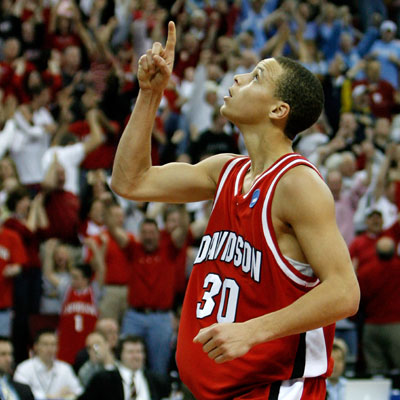
It is very possible that sweet-shooting Stephen Curry could be drafted before the New York Knicks' first-round pick in the upcoming NBA draft.

Missing out on Curry would be a missed opportunity for the Knicks, who choose eighth, because he would be a perfect fit for Mike D'Antoni's system -- and, it shouldn't be ignored, because of what he is saying.

Curry did something Thursday that you don't normally see from players before the draft, and this might be a reason why he's not your normal kid coming out of college early: He said which team he'd prefer playing for, and it wasn't the team considering him with the highest pick.

The former Davidson star said he has received interest from Oklahoma City, which has the No. 3 pick, Washington (fifth) and Minnesota (No. 6).

But he also said this (New York Times): "If I could be picky, yeah, it would be nice to have that kind of setting: Madison Square Garden."

And he wasn't even in New York when he said this. He was actually in Charlotte, in the area where he's lived his entire life, working out for the Charlotte Bobcats.

Curry said he "wouldn't mind" playing in Charlotte, but he was clear in saying that New York is his No. 1 choice.

He should be credited for coming out and saying his preference, especially a full three weeks before the picks are made June 25. Any team who drafts him knows it'll be getting a high-character player, a team guy and a winner -- we can assume that after watching the way Curry carried himself in the national spotlight for over a year at Davidson.

But the preference factor shouldn't be ignored, either. No, Curry isn't another Steve Francis, who demanded a trade from Vancouver -- a beautiful, fun city, by the way -- after being drafted by the Grizzlies. However, I'd have to think he might just practice a little harder, take a few more jump shots each day at practice, if he were in a Knicks uniform.

He'd be happy and dedicated to the team as long as D'Antoni is coach, and the Knicks would be fools not to give the run-and-gun-system-coaching D'Antoni a few more years to turn around the mess created by Isiah Thomas and others.

Finally, he'd be a good fit on the court -- where it matters most. Obviously, he can get up the court quickly, and his quick-release jumper would work perfectly on fast breaks. He'd have no problems getting his shot off every time down the floor or using it to fake defenders and create off the dribble.

He's not the most polished player, of course. His defense needs a lot of work, and he doesn't exactly have an NBA body.

But when was the last time a D'Antoni team was associated with defense? Let's not forget who his star was in Phoenix -- yep, Steve Nash, who continues to be one of the worst defensive players in the league but won back-to-back MVPs and led a handful of Phoenix teams to highly successful seasons.

Curry will never be a Nash. He's more of a shooter, less of a point guard. He'd do better playing off true point guard Chris Duhon and extending defenses with his jump shot.

And he'll get better -- there's no doubt about this. Guided by his 3-point-shooting expert father, Dell Curry, he'll work extremely hard and improve both physically and mentally during his early years in the NBA.

It'd be a risk for the Knicks to trade up to get him, but in a weak draft he might be worth it.

At least they know what he wants -- to be in a Knicks uniform.

That's more than most teams know about potential draftees and their dream jobs.

Friday, May 15, 2009

Billups proves to be one of league's most valuable players

ON BASKETBALL

Give yourself a slap on the back if, way back in November, you saw this one coming:

The Detroit Pistons, with their six consecutive trips to the Eastern Conference finals, swept -- in embarrassing fashion -- in the first round of the NBA playoffs.

And, just as shocking, the Denver Nuggets, with their five straight first-round exits and not a run past that round since 1994, in the Western Conference finals -- even getting there before the West's heavily favored Los Angeles Lakers (who face a do-or-die Game 7 against Houston Sunday).

I, for one, didn't see it happening.

Which means, of course, that I was among the minions who didn't grasp just how valuable of a player Chauncey Billups is.

Because adding Billups, really, is all that changed personnel-wise for the Nuggets. He came over from Detroit along with Antonio McDyess, who ended up back in the Motor City, and Allen Iverson -- and all his talent -- was shipped to Detroit.

On the surface, the Pistons were getting the better player, the more athletic player, the more accomplished player.

Except for one thing -- Billups has an NBA title, not to mention a Finals MVP, while Iverson has none (and, at this point, it looks like he'll retire without a ring).

The reason for this is simple: Billups runs a team better, way better, than Iverson. He gets along better with his teammates, he helps foster a good camaraderie in the locker room.

And he builds a winning environment built on solid self-confidence.

That's the way these Nuggets, who are an impressive 8-2 in the playoffs -- a record only bested by Cleveland's dominant 8-0 mark -- are playing. They've got a swagger about them that says, "Bring it," but at the same time, they're playing with a looseness that you'd associate with an underdog.

And, believe me, they have a 50-50 shot of making the Finals, regardless of whether they take on the mighty Lakers or the Yao- and T-Mac-less, upstart Rockets in the next round.

Meanwhile, the other result of the trade was a mess. It was no secret that Joe Dumars, the Pistons G.M., had no intention of holding on to Iverson after this season. The trade was more of a looking-to-the-future move, aimed at creating valuable cap space to sign a big-time free agent.

But no one thought the Iverson Experiment would go so poorly, with the one-time MVP never fitting in with his Detroit teammates and eventually calling it a season with a purported back injury.

He'll, more than likely, end up in a starting backcourt next season. But don't expect an Iverson-led team to ever smell the Finals again.

We'll have to leave that to Billups, 32, who has looked anything but aged and worn down this season. Along with Carmelo Anthony, Kenyon Martin, J.R. Smith and other valuable role players, it's not unrealistic to expect the Nuggets to make deep runs into the playoffs for a good three or four years.

Who, in November, saw that coming?

It's not too far-reaching of a statement to say the Nuggets are a completely different team since the trade.

And the following is a factual statement: Only one NBA player has made a conference finals series the last seven years.

That man is Chauncey Billups.

Sure, he's been blessed with great talent around him in Detroit and Denver. But neither team was close to being a title contender before he joined it. And while Rasheed Wallace was a big mid-season acquisition for the Pistons during their championship run, there was still no questioning who led them to the upset of the Lakers in the Finals.

Anthony is clearly the Nuggets' most talented player, and even Smith is more explosive than Billups, but the point guard is the team's most indispensable player.

Just look how far -- or, not so far -- Denver got during 'Melo's first five seasons.

Now, the team is just four games away from reaching the Finals with a chance to win its first NBA crown.

And, appropriately, it would be led to that title by a hometown hero who continues to prove his worth to even those outside of his home state.

Just ask the Pistons how valuable he is.

Tuesday, May 5, 2009

Celtics show, again, the importance of experience

ON BASKETBALL

So the Boston Celtics are down, once again, 1-0 in a best-of-7 series.

So they lost the first game on their home floor.

So what?

The Celtics might be down, but they aren't panicking. And something tells me they'll find a way to fight back and oust the Orlando Magic from the playoffs with or without Kevin Garnett.

That "something" is experience.

Each postseason, every NBA analyst gesticulating on your TV screen mentions it, says how "important experience is this time of year." And most of the time an "intangible" gets so much attention, it's overrated -- just something for all the talking heads to blabber about.

But in the NBA playoffs, as the Celtics have proved in the past two postseasons, experience really can make a difference. It can separate a great team like the Celtics from a young, talented team like the Bulls. Or an untested playoff team such as the Magic.

Just take Game 7 of their epic series against the Bulls, a series that has to go down as one of the greatest of all time even if Boston is quickly dismissed from the postseason.

In that game, the Bulls' most talented player was rookie Derrick Rose. And while he was good at times -- especially in the third quarter -- he committed a trio of key turnovers and didn't control the game the way a veteran point guard would.

Boston's Rajon Rondo wasn't any better, but that wasn't too surprising considering he's the Celtic's youngest main-rotation player.

The guys who knew what they were doing, who knew how to handle a Game 7, were the veterans.

Paul Pierce and Ray Allen found ways to get to the free-throw line in crunch time and then calmly sank the freebies. They made 16 of 17 free throws and the Celtics converted 30 of 39.

And then there was Eddie House, the sharp-shooter off the bench. He'd been a no-show for much of the series, but in the deciding game he continued to do what the team asked of him -- shoot 3-pointers.

And they went in ...all four of them. Take away House's 16 points, and we're talking about a Bulls-Magic series right now. House has been in the league for eight years and has played in his share of playoff series. He knew exactly what his role was.

Ben Gordon tried in vain to be the strong veteran presence for the Bulls, playing poorly on a bad hamstring in the second half after a quick start. Without an A-plus game from him, Chicago was left to rely on a group of very capable but inexperienced players.

Another Bulls veteran, Kirk Hinrich, came off the bench and played brilliantly. It might have seemed a surprise to the casual viewer, but he understood how to play in such a situation.

Still, the Celtics' veterans -- let's not forget the eight points and three rebounds Brian Scalabrine contributed -- were too much to overcome even minus K.G.

Now, after a loss to the Magic, the masses are out saying that Boston desperately needs Garnett to combat the NBA Defensive Player of the Year Dwight Howard. He'd certainly help (obvious statement of the column). But Boston may also win this series without him.

Orlando is on the cusp of greatness. It has a reliable corps in Howard, Rashard Lewis and Hedo Turkoglu plus the injured Jameer Nelson. But they're still inexperienced compared to the Celtics, and I expect that to shine through at some crucial point in the series.

Let's not forget -- Boston had to survive two Game 7s and win a Game 6 in Detroit to get to the Finals a season ago. Nothing ever comes easy for the Celtics, and it certainly won't happen that way in these playoffs.

They may be exposed as thin inside sans Garnett. Their bench may have off games, as was the case, really, until Game 7 of the first round.

But these Celtics won't get beat mentally, won't let a dire situation negatively affect them.

And that can be attributed, in large part, to that word all the former-players-turned-analysts make sure to mention during each 30-second sound bite.

Experience.

Monday, April 27, 2009

Pistons' wasted season comes to an ugly conclusion

ON BASKETBALL

If you're a Pistons fan and you thought the end of the past four seasons since the 2004 championship were frustrating, you were spoiled.

Badly.

Because the end of this Pistons campaign had to be the epitome of frustrating for anyone associated with the franchise. Detroit had it string of six straight Eastern Conference finals appearances snapped in ugly fashion, getting swept by the Cavaliers in a completely one-sided series.

All the games were decided by double figures. None of them, really, were ever in doubt. Even when the Pistons were in a game, it was usually because likely NBA MVP LeBron James was on Cleveland's bench getting a nice, long rest before coming back in to finish the job.

Detroit was the first team eliminated from the playoffs, which technically makes sense. After all, it had the worst regular-season record of the 16 teams and was playing against the team with the league's best mark.

If anything, the nine-day series -- which probably could have taken place in about six days and saved everyone a few wasted ones -- proved that as long as the 82-game regular season is, it shouldn't be taken for granted.

Throughout the season, we kept hearing the Pistons say that they didn't think they were far from becoming a good team, from developing a strong chemistry. I guess talk is cheap (I think I've heard that before).

What actually happened -- what actually matters -- is that the group of players led by rookie coach Michael Curry and second-year point guard Rodney Stuckey, who is more of a hybrid, never clicked. Never. Sure, there were a couple minor winning streaks, but no groove was ever found.

And that's what is needed to be a good playoff team. That's what is needed in playoff games, when things aren't necessarily going well, to turn momentum in your favor.

These Pistons never found that.

That's what has to be frustrating to everybody associated with the team.

And they underachived, plain and simple.

It's easy to point to the trade of Chauncey Billups to the Denver Nuggets for Allen Iverson as the main reason the Pistons fell apart, and that certainly hurt the team -- especially considering Iverson never fit in the rotation and then was lost for the season to a purported back injury.

But even sans Billups, this team should have been better than the eighth seed in the East. This team should have been a middle seed that at least got close to making the second round.

Consider the players on the Pistons who were a part of many, if not all, of those conference finals runs -- Richard Hamilton, Rasheed Wallace, Tayshaun Prince and Antonio McDyess in the starting lineup.

Those four, plus Stuckey and an improved bench, should have been enough for the Pistons.

But Curry struggled mightily to develop the team sans Billups, and the veterans simply didn't play up to their capabilities.

Hamilton had a hot streak after Iverson went out, but he didn't maintain it down the stretch. And Wallace and Prince simply often didn't show up to do what they were supposed to.

Curry deserves a lot of blame, but the Pistons veterans should have known what they had to do to make the team successful. Heck, they're almost as old as Curry.

What it boils down to is a lost season, a season that needs to be forgotten by the organization as quickly as possible and moved on from.

And now, really, it is clear that changes are needed.

That was the rhetoric after each of the last couple years ended in the conference finals, and that talk probably helped fuel the Billups-Iverson deal. And look how that worked out.

This season proved that when you have something pretty good -- not perfect, but very solid -- you need to really think before breaking off a big piece of it.

Now Joe Dumars needs to break off some more pieces -- mainly Wallace and Iverson -- and try to build up a consistent winner again. It's almost akin to the job he originally inherited.

Is Prince unmovable? I wouldn't think so. What about Stuckey? Can he run the point for an NBA championship team? That's another question to consider.

A long, busy offseason looms for Dumars and his aides.

And it must be welcoming, considering the way this lost season went.

Tuesday, March 3, 2009

Pistons rediscover winning formula minus the 'Answer'

ON BASKETBALL

These are the Detroit Pistons we know, the group of players we'd grown accustomed to watching win 50-plus games a season.

Yeah, Chauncey Billups made sure to play one of his best games on Tuesday in his return to The Palace of Auburn Hills as a Denver Nugget — a "You shouldn't have let me go" performance.

But his team lost the game, 100-95. And it was Detroit's third straight victory, getting it back to above .500 at 30-29.

In the grand scheme of the past several years, of successful regular seasons piled on top of each other, three straight wins should be nothing to this franchise.

But not these three. By beating Orlando and Boston on the road and the Nuggets at home, the Pistons proved that they're still a team to be reckoned with in the Eastern Conference.

As long as they're aligned right, that is.

Because what the trio of W's has made crystal clear, more than anything else, is that Detroit is at its best not like, well, it was previously constructed (if that makes any sense).

During the franchise's darkest days since the early '90s, which culminated last week with an eighth consecutive loss, rookie head coach Michael Curry made the grand error of starting future Hall-of-Famer Allen Iverson.

Seems like a smart move, right? Putting the four-time NBA scoring champion in the lineup couldn't hurt, right?

Very, very wrong.

Because, for one, that meant sending Richard "Rip" Hamilton to the bench for the first time, probably, since he was a skinny kid hoopin' in Coatesville, Pa.

On the surface, Curry's move is mildly understandable. Iverson is, after all, the more explosive player, the guy who can do more things. To simplify, the better overall player.

But what Curry didn't realize in making the move is what the effect on the team's synergy would be. And that, folks, was his big mistake.

As good as Iverson is, he doesn't fit with the Pistons' other starters. Too often in games, Iverson would be on the perimeter dribbling the ball through his legs 1,097 times while the other four guys watched. There'd be no on-court chemistry, a lack of movement and team basketball.

In L.A. that might work, but not in Detroit. The Pistons have always won with team basketball.

Which brings me back to Hamilton, who knows the tendencies of starters Tayshaun Prince, Rasheed Wallace and Antonio McDyess like he knows the roads of Coatesville. They've been winning, after all, for several seasons together.

Rip is not as familiar with the bench players he often took the court with during his stint as a bench player — youngsters like Arron Afflalo and Amir Johnson.

So what the move did was weaken the Pistons' starting lineup and their bench rotation.

The losses followed.

And they might have saved a going-nowhere-fast season.

Last week, with the L's mounting — and some critics already calling for Curry's ouster — Iverson made the coach's decision easy by hurting his back in Detroit's 90-87 loss at New Orleans.

And, just like that, Hamilton was back where he belonged.

Of course, Curry hasn't actually done anything yet, because Iverson is still hurting. But it's clear that when he returns, he'll be coming off the bench. Rip is back in the starting lineup for good.

And if A.I. accepts his role, he has a chance to become the most dynamic sixth man in the league. No other team has any player close to Iverson's caliber starting games sitting.

That's what could make Detroit dangerous. It's already proven during this three-game stretch how good it can be sans Iverson. It could cause some serious havoc if Iverson embraces running with the second-tier guys, acting as their leader.

No, I don't see the Pistons getting by both Cleveland and Boston to the Finals. But compared to the destination I had them pegged for just a week ago, their prospects are now rosy.

Iverson has said repeatedly the past few years that all he's missing is an NBA championship. He also knows that he'll be gone after this season, dumped into the free agency market when teams are stuffing their pockets for 2010.

So there is plenty of incentive for him, just like Stephon Marbury, to make the most of his new niche on a team capable of doing some pretty big things.

And even if the end of the season is another disappointing playoff exit, these Pistons should be able to look forward and feel confident with the future's pillars — Hamilton, Prince and point guard Rodney Stuckey — in the starting five and playing well together.

Trading Billups still might have been a mistake. The past week hasn't completely erased the trade's effect.

But it's shown that maybe, just maybe, these Pistons — present and future — will by successful without their former Mr. Big Shot.

Thursday, January 8, 2009

Charges need to be earned in college basketball

ON BASKETBALL

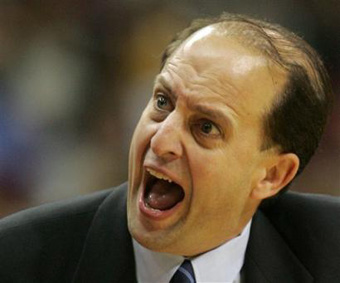
The head honchos at ESPN picked a perfect night to put NBA commentator Jeff Van Gundy behind a microphone inside Cameron Indoor Stadium.

Anyone who who has watched a broadcast featuring the irascible Van Gundy knows that he may be short and — to be nice — not the best-looking fellow. But he also doesn't hesitate to speak his mind, and most of the time he's right.

I was on press row for Duke's 79-67 win over Davidson Wednesday, and therefore didn't get to hear Van Gundy on the air. But I wasn't at all surprised when after the game a friend told me that Van Gundy had made a big stink about a number of charges that were called during the game.

I couldn't agree more.

And this wasn't just a case of "Duke getting all the calls." On both ends of the court, players were drawing charge while they stood, basically, under the basket. This has got to stop. While the officiating was subpar Wednesday, officials making such calls is not uncommon in the college game.

There are many things I like about college hoops that the pros need to adopt — the 1-and-1, for instance. But college basketball needs to take a hint from the NBA and institute the semi-circle rule for taking charges.

In pro basketball, a defender must be outside of the painted half-circle to draw a charge. This prevent a player from stepping in front of a player at the last second as that player is scoring a layup. It makes great sense, especially in the NBA where players are so athletic.

Can you imagine a small guard jumping in the path (or below) of LeBron James when James is in mid-air en route to a thunderous one-handed dunk ... and a charge being called? Didn't think so.

Well, there are plenty of athletic players in college. And we all know that for a lot of players, college is just a one- or two-year basketball factory before they turn pro. So why not institute an NBA rule that would not only give refs a less-arbitrary method of making the block-charge call, but also help prepare college players for the next level?

When a good pass is made to an open player in the post and he turns right into a defender and puts up a layup as the defender flops to the ground, the basket should count and play should continue. It is ludicrous for the defender to "earn" a charge, not to mention cheers from the crowd, for doing nothing but flopping.

Alas, that's what happened a couple times during Wednesday's game. Van Gundy didn't ignore the indiscretions.

The problem is how endearing of a play taking a charge is. During the early stages of a player's development — during high school or even middle school — he's encouraged to "sacrifice his body" for the good of the team, to be a "team player." Taking a charge helps build team chemistry, helps teammates believe in each other and their dedication to the team.

And that's all great and mushy, but no coach should be teaching players to attempt to take charges under the basket. Unfortunately, that's the case because the game is too often called that way — except in the NBA.

Charging calls aren't going away. Yes, there aren't as many called in the pros; instead, we have to watch the boring "block" get called more often, and who likes that? But there still are charges, those calls that pump emotion into players and fans (and even refs, it seems, as they thrust their arm forward the other way).

They, supposedly, mark special defensive plays. But I got the sense Wednesday that a charge meant hardly anything anymore. They were almost as regular and mundane as a blocking call. In fact, I think there were more charges than blocks called.

That should rarely, if ever, occur. Obviously, a change must be made.

And maybe ESPN should let Van Gundy work some more college games. Heck, somebody needs to point out the game's issues and solvable problems.

Thursday, December 18, 2008

Wouldn't you like to be Stephon Marbury?

ON BASKETBALL
Question: If you could live the life of any athlete right now, whose would you choose?

Obviously, there's Tiger Woods. Dude makes yacht-loads of money, has a gorgeous wife and, oh yeah, is well on his way to becoming the best golfer of all time. But we're talking about today, and at this moment Woods can't even hit the Big Dog.

No, being Tiger right now isn't the ideal situation.

OK, how about LeBron James? Dude's one of the best two players in the NBA, is so loved by fans that the folks in Morose Minnesota gave him a standing ovation Wednesday, and he's quickly becoming a global icon. As an added bonus, you get to be boys with Stephen Curry.

Not bad, but LeBron continues to carry a heavy load for the Cavs. At this time of year, I'd prefer a little R & R.

Well, it is the baseball offseason, correct? Players don't have to report for two months. So being C.C. Sabathia would be tight, right?

Except that it wouldn't. C.C.'s going to be under such intense scrutiny next season, he's probably already hitting the treadmill two hours a day to try to trim that stout frame for the New York media hounds. Don't want them blaming your girth when you lose a game in April.

So forget about CC. Mo money, mo problems.

Except, however, when you're talking about Stephon Marbury. Yep, out of all the great players in the sports universe today — the Woodses, the Federers, the Kobes, the Peytons, the A-Rods and the Phelpses — none of them have a better life than Marbury.

Technically, Marbury is still a member of the New York Knicks. In fact, he was at their game Tuesday night against the Lakers. Only thing was, his bottom was plastered to a court-side seat at Staples Center alongside the likes of Jack Nicholson and the rest of Los Angeles' finest.

Marbury, sporting a hot-looking black leather coat, watched a tad of the game, did some texting and talking on his mobile device, and even conducted an interview with reporters during halftime. When he said, memorably, "I'm still earning my check by doing nothing. I'm staying in shape. My mindset is to enjoy my life."

In truth, Marbury is doing nothing. For all intents and purposes, he's unemployed — only his unemployed compensation for this NBA season is $21 million. And while I'm happy that he's staying in shape and enjoying life, he must be corrected on this: he is not earning that rather hefty paycheck. Not in any way.

But please don't blame Marbury. Seriously — the man's doing nothing wrong. It's obvious that New York coach Mike D'Antoni wants nothing to do with the point guard, and after a couple failed attempts at getting him to enter a game from the bench, their relationship was over.

After a fractured meeting with team president Donnie Walsh, Marbury was banned from all Knicks games and practices. In fact, he had to make sure that it was OK for him to attend Tuesday's contest in L.A. since it involved his, eh, team. (And it was fine; no violation.)

Such is the life of the 31-year-old from Brooklyn. I mean, just consider this for a moment. A kid like Marbury, who grew up dirt poor with nothing but a dream. Now he's getting paid a fortune, a life's salary, to do absolutely nothing. Life couldn't be grander, right?

Well, Marbury is actually handling this correctly. While he said he can't wait to be freed from his contract, which expires after the season, he has no plans of bailing out the Knicks for their woeful financial decisions (on a side note, Walsh must be loving Isiah Thomas right now).

And why should he? They agreed to pay him a certain sum of money. Now they want nothing to do with him. He owes them nothing, and I doubt he thinks very highly of the franchise.

Marbury said another NBA team has expressed interest in him. If so, and if he gets a new contract after the season, good for him — and maybe good for that team, as long as they are very careful not to pull an Isiah and do some deadly overspending.

Heck, maybe after a year of free millions, Magnanimous Marbury will make an appearance and agree to pay for a small salary.

Or maybe not.

But back to the question...

Come June, I'd like to be Tiger; he'll be hitting the Big Dog with regularity.

But at this moment, no athlete's life is better than Stephon Marbury's.

Friday, December 5, 2008

Now is the time for Curry to tinker

ON BASKETBALL

Relax, Pistons fans. Yes, your team isn't exactly putting together winning streaks. Yes, the 11-6 record isn't up to the standard of the past six seasons. And yes, those stinking Cleveland Cavaliers and their New York-loving superstar are up three and a half games on your team in the Central Division...

Relax. Because every fact from the above paragraph has almost no meaning.

Here's what does matter: The Pistons will be back in the playoffs come springtime. I'd bet this nice laptop plus my car on that.

Here's what else is important: First-year coach Michael Curry knows what he's doing. He's performing admirably at focusing on the regular season, but simultaneously keeping his eyes on the only objective that really matters for this recently underachieving franchise: making it back to the NBA Finals and winning a championship.

Curry knew what he was getting into when he accepted Joe Dumars' blessing. A 60-22 regular season might be nice for a day, but coupled with another exit from the Eastern Conference finals, it would mean nothing and impress no one. The same can be said of winning another division title or even finishing with the conference's and/or league's best record.

Who cares?

Curry knows all this, and that's why — even here in early December, when the playoffs seem decades away — he is thinking ahead with each game. He won't admit that, but he's simply doing his job.

And that entails establishing a rotation of players he can trust come mid-April. Not just five starters and maybe a sixth man, but a larger group of players who have all played substantially and will have the ability to play big minutes — if needed — when the games count most.

The plebe coach showed off his willingness to play anyone in a loss the other night to the Portland Trail Blazers. When a lineup that included reserves Amir Johnson, Rodney Stuckey and Arron Afflalo made a run to give the Pistons a brief fourth-quarter lead, Curry stuck with his backups and left starting small forward Tayshaun Prince on the bench the entire final quarter.

Detroit went on to lose, and Prince didn't understand why he hadn't been reinserted, but Curry backed up his decision by saying Prince hadn't played well. And the numbers verify his impact on the game: Detroit was outscored by 23 points while he was on the floor.

This doesn't mean, of course, that Prince is less talented than Johnson or couldn't have helped lead Detroit to victory. But Curry went with the players who had gotten their team back in the game. And despite the loss, the trio had to gain confidence from knowing that their coach believed in them to make plays during crunch time. (And, again, the outcomes at this point don't matter so much.)

The move to go with his reserves wasn't isolated, either — although I wouldn't expect starters to sit out too many more entire fourth quarters of close games. Curry said earlier in the week that he expects to continue to cut his starters' playing time at least a little bit. This is a smart move in two respects.

One, it keeps the older starting lineup more fresh. Allen Iverson said recently that he can't find his rhythm playing fewer minutes than he's averaged during his career. Well, the 33-year-old has 65 games to figure out how to find it. That's the benefit of the Pistons' trade for the superstar happening so early in the season.

Rasheed Wallace and Richard Hamilton need to be ready to play their best basketball, not to mention be healthy as can be, come playoff time. It's no secret that the Pistons go as Wallace goes. If he's playing well and finds the range from behind the 3-point arc, Detroit is a very dangerous team.

The Pistons are even more potent when they're getting consistent production from their bench. As we saw in last year's playoffs, Stuckey can play with and against the top dogs and isn't afraid of big-time situations. With the benefit of more minutes under his belt, he'll only become better. Afflalo has shown he can not only lock down on defense, but he can shoot the ball too. He just needs the minutes in real-game situations to become more confident in that part of his game.

Detroit will surely benefit from the return of Antonio McDyess — and his mid-range shooting ability — when he returns off waivers probably next week, but it would be smart to bring him off the bench. By inserting him into the lineup instead of current starter Kwame Brown, Curry would effectively have his five best offensive players beginning the game on the court.

I don't like it. At least one forward and one guard who can score need to be stashed on the bench so that when games start out poorly for the starting five, they can be inserted to provide a "spark," an offensive shot to the arm. When McDyess returns, he'll be Detroit's lone reliable scorer at the forward position off the pine (if, indeed, that's where he begins games).

Of course, there remain 65 games for Johnson, Brown and Jason Maxiell to get valuable experience and gain confidence for the postseason. And with the way Curry's coaching this team, I expect to see some positive gains from them. If nothing else, he'll determine who he can trust in tight spots.

So, relax, Pistons fans. A loss in December means close to nothing.

Unless, of course, it puts the Lions closer to 0-16.

Wednesday, November 12, 2008

A loss that says a lot about the Hawks

ON BASKETBALL

Typically, I'm not a proponent of writing about NBA teams and their fortunes in November. Or December or January, for that matter.

The season is too long, beginning in mid-fall and lasting until the beginning of summer. Entire buildings are constructed, entire pregnancies are survived, the world is sailed around during NBA seasons.

So, obviously, a lot can change during the course of the 82-game regular-season grind, followed by the protracted, made-for-TV playoffs. But, just two weeks into the 2008-09 season, I've got some bold predictions for you:

1. The Atlanta Hawks will make a strong run at winning the Southeast Division, battling the Orlando Magic to the end. Heck, scratch that last statement (I'm feeling really bold). And forget what my recent NBA preview said:

The Hawks will win the Southeast. Yep, you heard it here first.

2. The Atlanta Hawks will not be a "sleeper" in the playoffs. Rather, they'll be a contender. They will likely win one series and maybe two. And don't discount them when putting together your list of teams that can make a run at the defending-champion Boston Celtics.

Why am I writing this manifesto, here on Nov. 13, when half of America doesn't even know basketball season is underway? Well, let's just say the Hawks have made a stronger-than-Whiskey statement with their first seven games, including the only one they lost.

That happened last night, when they visited the last venue in which they lost a game with any meaning. Back on May 4, a Sunday afternoon, Atlanta traveled to Boston for a grand opportunity: a chance to knock off the heavily favored Celtics in Game 7 of the first round and advance in the playoffs.

It laid an egg, playing like the young team it was — immature, impatient, unfocused.

The Hawks were great at home during the series, winning all three games in HotLanta, making basketball relevant in the city for the first time since Dominique Wilkins routinely threw down thunderous putback dunks. But when it came to winning on Boston's home court, it was clear that the team still had to grow up, still had to find that steely focus that championship contenders maintain regardless of their next game's venue.

Well, I have no idea what most members of the Hawks did this summer — although I read an article that said Marvin Williams came back to Chapel Hill to work toward his degree, which shows his tremendous dedication, considering he spent just a single year playing for the Tar Heels. But whatever the players did, the came to training camp this fall a much-improved team both physically and mentally.

A lot was made of Josh Childress' departure for the great fortunes of basketball in Greece. Pundits thought the loss of their consistent sixth man would greatly hurt the Hawks. That hasn't been close to the case. Ronald "Flip" Murray and Maurice Evans have filled in admirable (although they're a fantasy owner's nightmare because they basically exchange having good games).

And the starting lineup has been one of basketball's best, as it showed in Boston Wednesday night. In the best game of the young season, the Hawks battled the Celtics down to the final seconds.

Williams, not known for his outside shooting, knocked down a 3-pointer — after the team's leading scorer, Joe Johnson, was double-teamed while driving down the baseline — and the Hawks took a one-point lead with 7 seconds remaining.

Of course the Celtics being the Celtics, Paul Pierce came back to make a difficult fadeaway jumper with 0.5 seconds remaining, giving Boston a thrilling 103-102 victory and ending Atlanta's perfect season.

But at 6-1, the Hawks have to be just as excited as Boston's fans were after watching their Celtics improve to 8-1. In two-weeks time, they have shown the NBA world that they definitely weren't a one-year fluke and that they definitely have the nucleus to maintain this type of play throughout the season.

At this point, I'd still rate Boston, Cleveland and Detroit — in that order — as the East's top trio of teams. But after them, it's a crap shoot. Philly has been disappointing this far, the Magic still don't play much defense and the Raptors are solid, but I still don't see championship potential there.

I'd make Atlanta my fourth-best team in the East right now. After making such a statement, I guess I owe you a few reasons:

1. In case you haven't noticed, Johnson is one of the NBA's best scorers. There's no doubt about it. Every night he's the focus of the opponent's defense, and every night he finds ways to score. He's a great shooter, he's a strong slasher, and he showed his passing ability by finding Williams for the go-ahead 3-pointer. He's a great lead-by-example guy.

2. Mike Bibby is the veteran presence the team needs. He's been through the playoff battles before (with Sacramento) and knows what it takes to win games like Wednesday's. And he plays the most important position, so when things start to slip, he can quickly get everyone back on track.

3. Al Horford will only get better. In just his second season, the Hawks' center is showing his potential. Just Tuesday, he scored 27 points and grabbed 17 rebounds. With Horford on my fantasy team, I was about to plan a party until I realized I was still losing. But in all seriousness, Horford has quickly proven that he's a legitimate starting center. And as we saw against Boston last season, he doesn't back down from anybody.

So there you go. Three reasons I'm not calling the fast start a fluke. Atlanta has the dogs to keep winning. Not at this pace, no, but at a good enough clip to win its division and get homecourt advantage in the first round of the postseason.

As it showed during this trip to Boston, basically the same group of players from last spring is now just as talented, just as hungry for success, more focused and certainly not intimidated by any opponent or any arena.

And that, to me, is enough to write such a glowing NBA column before even watching a full NBA game.

Sunday, October 12, 2008

Tyson Chandler understands the common man

ON BASKETBALL

Tyson Chandler
gets what a lot of athletes can't seem to grasp.

The New Orleans Hornets center doesn't pretend to know a lot about politics. In fact, he clearly stated on his NBA.com blog that he doesn't understand what a lot of politicians babble about (I'm with you, Tyson!).

But Chandler, 26, gets this: With the millions of dollars he's making, he can afford to pay higher taxes as a sacrifice for millions of others (no pun intended). Chandler attended a presidential candidate's rally in Indiana last Wednesday, and he came away overly impressed with the candidate.

I'm just as impressed with Chandler.

One reason for the divide between normal working-class Americans and professional athletes is the absurd difference in salaries. And athletes don't help themselves by greedily scrounging for that $67 million instead of $60 million. Average Americans making $35,000 a year shake their heads and turn off the tube.

Tyson Chandler is not one of those athletes. Hey, anyone has a right to their earnings and to vote accordingly (although, of course, there are many other issues to consider come election day). That's why lots of pro athletes vote Republican — so they can keep more of their millions.

There's nothing wrong with that.

But there's a lot right with what Chandler wrote on his blog. Chandler scribed how he might have to pay more taxes under a Barack Obama presidency, but he noted that all of his relatives would be helped by tax cuts. That's because Chandler is the only member of his extended family who makes more than $250,000.

It's a lot easier to make a decision — even a sacrifice — when you know it will benefit those whom you're close to. Chandler found that out at the rally in Indiana.

And, I'm positive, he earned a lot of fans in the process.

The more athletes like Chandler show they understand the everyday man's situation — and speak out about it — the less people will be turned off by their actions and words.

Who knows? Maybe down the line, Chandler will educate himself on the issues and turn politics into a passion.

In today's political climate, we'd be lucky to have such a man in a leadership role. And to think, he jumped straight for the NBA from high school.

Plus, at 7 feet 1 inch, he kinda stands out in a crowd.

Sunday, August 3, 2008

The not-so -appealing NBA

ON BASKETBALL

The upcoming Olympic Games have taken on new meaning for the United States men's basketball team.

Kobe, LeBron, D-Wade and company must prove that their country is still the king of the basketball universe. Anything less than a gold medal would say otherwise.

But the Olympics aside, the past month has not been a good one for David Stern's league. (And I'm not even gonna say Tim Donaghy's name, besides just doing it.)

All of a sudden, Josh Childress of the Atlantic Hawks bolted to play professionally in Greece.

Then went another player. And another.

And ... oh ... I just looked at the bottom line, and Orlando backup point guard Carlos Arroyo is making a exodus as well. He'll play in Israel now.

This isn't something that happens every summer, folks. This is a new phenomenon.

Bottom line: For players who aren't the centerpieces of their franchises, the NBA no longer holds the appeal it used to. Just playing in the world's best basketball league isn't enough any more.

I don't have Childress' phone number in my Fave Five. Actually, to be completely honest, I don't even have T-Mobile. But to get to my point, I can understand what Childress, Arroyo and many others — such as former Nets big man Nenad Krstic — are thinking.

Consider the lifestyle of a sixth man in the NBA. Sure, you're still earning more than people like me will make in four lifetimes. Sure, you're still living the dream. But you're on a team full of other stars who get all the attention. You're simply expected to do the dirty work, wash the dishes.

Now consider the life Childress will enjoy in Greece, playing for Olympiakos. First of all, I've heard from trusted sources that living in Greece isn't bad. Secondly, thirdly, fourthly and fifthly, Childress will earn more money (about $20 million after taxes for three years guaranteed); he can opt out of the contract after each season and still make the full $20 million!; his housing will be provided and he'll be given a car; and, as if that's not enough, he'll be a star. Fans will love him. He won't simply be considered Atlanta's sixth man.

Now tell me how that's not better than his situation in Atlanta. As long as a player is comfortable with living overseas, it's a no-brainer.

And I didn't mention the style of play. No offense to the NBA, but foreign basketball is more team-oriented. It's not all about the stars and one-on-one basketball. All five players on the court are involved in the offense.

Granted, a reason for this is that you won't find any LeBrons or Kobes in Turkey or Russia. There aren't players that dominant, guys who you can simply give the ball to and get out of the way.

And part of what makes most of the U.S. stars so great is their ability to create easy shots for their teammates, for guys like Childress. Outside of the money he got, Kobe Bryant, I'm sure, is a reason why bench playerSasha Vujacic decided not to join the exodus and stay with the Lakers. Bot only so many players are privileged enough to play on teams like the Lakers and Celtics.

Childress was on a team — the Hawks — with an aging point guard (Mike Bibby) and a star (Joe Johnson) who knows how to do one thing: shoot. Staying with the Hawks was an invitation to stay the player he was without much room for becoming a mainstream-type guy. With a few signatures, he changed all that and became much richer.

Sounds like a tasty deal to me.

This is just the beginning, basketball fans. As we've seen in international competition the last five years, the level of play around the globe is only getting better each year. Don't expect this trend to end. The quality of play in the NBA, however, hasn't improved. And there's no reason, really, to expect it to.

When high-schooler Brandon Jennings chose to play in Europe for a year instead of college, American players suddenly noticed the overseas option. Playing abroad is no longer some abstract idea to U.S. hoopsters. It is a legitimate option.

Even for players not seriously considering playing overseas, it could be used as leverage against an NBA team. A player in contract negotiations with his team could use a better offer from a European outfit to garner an increased offer to stay in the States.

None of this can be considered good for the NBA. Only a couple years ago, the focus was on the hordes of international players coming to the U.S. to join the NBA. Italian Andrea Bargnani was taken with the No. 1 pick in the 2006 draft.

Now, could a player of Bargnani's caliber decide to stay in Italy instead? I doubt it — the allure of being drafted in the top five of the NBA draft and becoming a franchise-type player is still very strong. But for lower-rung guys — potential second-round draft picks — a career in Europe could be much more satisfactory. A guaranteed contract (something second-round picks don't get); a spot in the starting lineup right away — players could decide not to come to U.S. in the first place.

All of this is speculation, of course, but what can't be doubted is that international basketball is dunks and jumpers better than it was a decade ago. And, just as important, international teams have plenty of cash to dole out to talented players (foreign or American).

Will the NBA miss Josh Childress, Carlos Arroyo and Nenad Krstic next season? No, don't think so. Their jerseys weren't exactly big sellers (I think). But their respective teams might miss them. And from now on, teams better pay attention to their players who are looking for new contracts — if, of course, they covet the players.

Because otherwise, such players might be gone in the snap of a finger. Headed for more money, better cuisine and stardom in a foreign land.

Wednesday, July 30, 2008

Don't dismiss Kwame Brown just yet

ON BASKETBALL

When Joe Dumars pledged to "shake things up" this summer, this wasn't exactly what you were expecting.

OK, that's a guess. But I'm pretty confident in it. By all means, tell me if I'm off base. But signing serial underachiever Kwame Brown to a two-year contract doesn't exactly give the Pistons a fresh identity heading into the 2008-09 season.

And that's just fine. That's not the point of the move. There's still time for more serious shaking up to occur -- maybe even during the season.

But let's talk about this deal while it has the spotlight. What's the first word that pops into your head when the two words "Kwame Brown" are mentioned?

Scrub.

Malcontent.

Immature.

Lazy.

All true, but you could also throw out the following:

Potential.

Athletic.

Young.

Those three words are why this deal makes sense. Dumars is making a minimal investment in a guy who could either dedicate himself to being a strong role player on a contending team, or remain the staple of inconsistency he's been his first seven years in the league.

If the former is true, then great. The Pistons definitely need depth and size in their frontcourt. The 6-foot-11, 270-pound Brown provides that. Rasheed Wallace and Antonio McDyess aren't getting any younger or stronger. Big bodies shouldn't be taken for granted.

Of course, if the latter is true, then no biggie. The Pistons can dump Brown after two seasons -- if he chooses to pick up the option for his second year. They would only have lost $8 million on Brown. No, not exactly a disastrous New York Knicks contract.

If you think $4 million a year is a lot for a role player, then you're behind the times. That's what NBA veterans make these days. And if they don't receive offers for such money, they bolt for Europe. This summer has seen as many NBA players sign with European teams as foreign players join the league from abroad.

It's all about the money. And paying $4 million a year for a young big man with some potential is a worthy investment.

Do I think Brown is going to turn around his career in Auburn Hills? It's really hard to tell. My gut tells me no. But it's certainly the best situation for him. He'll be pushed by new Pistons coach Michael Curry, who won't take any indolence from him. He'll receive plenty of instruction from veterans Wallace and McDyess, but he won't be berated and demeaned like he was by Michael Jordan during his tumultuous time in Washington.

As witnessed by Jason Maxiell's maturation into a very solid frontcourt player off the bench, Detroit is a good place for a player like Brown. With Maxiell and the young Amir Johnson on the Pistons' bench, Brown will have to fight for every minute of playing time. There will be no free minutes. Being in an environment ripe with talented players will force Brown to dedicate himself to the game if he wants to become part of the rotation.

All good things.

And Brown has solid potential. OK, not No. 1 pick potential, which is what M.J. (somehow) saw in him. But with the right work ethic and environment, Brown could become a critical part of the Pistons' charge to finally return to the NBA Finals. He has the size and athletic ability. He just needs a lot of fine-tuning.

Do I like Kwame Brown as a player? Nope.

Would I call him a scrub right now? Yeah, though not to his face.

But Dumars, like most of the time, knew what he was doing.

He made a low-risk investment.

It could have no return. It could net a big return.

Only time will tell.

Thursday, July 3, 2008

Brandon Jennings trapped by the system

ON BASKETBALL

I love what Brandon Jennings is saying. I love the publicity he has gotten with his words.

Unfortunately, however, he'll be owned by the system.

If the class of 2008's No. 1 prospect gets back a SAT score Thursday that is good enough for him to enroll at Arizona in the fall, he'll head to Tuscon -- if he knows what is best for him.

Jennings has said in the past week that he's considering playing in Europe for a year -- and earning a bundle of cash -- instead of honoring his letter of commitment to be a Wildcat for one season (he has already confirmed that he'll enter the 2009 NBA draft). It's the first time since the NBA's age-limit rule was instituted prior to the 2006 draft that a high-school graduate has considered such an option.

Of course, a big reason for this is that Jennings needs his third go-round at the SAT test to exceed a certain score just to attend Arizona. If that doesn't happen, he's definitely off to Europe and the land of professional basketball.

But the test more than likely will be fine. Jennings had a solid score the second time he took it, but the NCAA didn't allow it because he did so much better than his first time around. Jennings simply said that he tried harder. Whatever the case may be, I expect his score to get him into Arizona.

And I'm pretty certain he'll be playing for Lute Olson in November.

Which is too bad -- it'd be nice to think that college basketball is more than just a one-year feeding system for the NBA's newest stars. If the draft that just happened is any indication, however, that's exactly what it has become.

This isn't to say that college basketball doesn't remain a great sports spectacle. I still love the games, the team play, the madness. But thanks to the NBA's rule, we become enamored with players -- and their respective teams -- one year only to see them declare for the association before spring exams are complete.

Brandon Jennings is the next in line.

I'd love for him to buck the trend, to hop a plane for Madrid or Moscow, to learn the intricacies of the international game before being drafted into the NBA next year. The truth, however, is that he'd gain much more exposure -- and I'm not talking about the sun -- from playing at Arizona as opposed to running with the bulls.

He'd also likely get more playing time, more offensive freedom from Olson and, ultimately, more of an opportunity to shine for NBA scouts. Come next June, Jennings' stock would be higher coming off a year in college, and, thus, his financial future would shine brighter.

Money, money, money. That's what it boils down to.

Jennings doesn't give a hoot about winning for the Wildcats, or impressing the coeds. He has one goal in mind -- to be a star in the NBA. There's one obstacle in his way -- David Stern's age limit. Jennings, and his agent, just have to decide what would be the better stepping stone to the fulfillment of his dream.

The evidence is right in front of them: In the recent 2008 draft, four of the top five picks were one-and-done college players. The lone foreign player in the top 10 -- and one heck of an established player -- went No. 6. In all, a record 10 freshmen were chosen in the first round (and earned guaranteed cash). Four overseas players made the top 30.

In a year, Jennings almost definitely will be a first-round pick regardless of where he laces 'em up this fall. But where he gets drafted on the rookie pay scale is up in the air, and more endorsements tend to find the higher picks.

Welcome to Arizona, Mr. Jennings. No need to attend classes. Just win games and help us sell jerseys. It's been eight seasons since our last Final Four.

That will be the story come November, and Jennings will get fawned over by the college-basketball media -- and rightfully so. Because he'll be gone before they know it.

And when "Brandon Jennings" is called next June in Madison Square Garden, he will be a household name in NBA circles -- a perfect scenario for Stern. He won't be some foreign star whom only the experts have heard of. He'll be one of the next batch of marketable rookies for the association.

As the NBA continues to reap the benefits of its monopolizing rule.

Saturday, June 28, 2008

The national-title game effect

ON BASKETBALL

Lost among the story of a record 10 freshmen getting taken in the first round of Thursday’s NBA draft was a story line that could be spun as a positive for college basketball.

I’ll call it the national-title game effect.

One by one, players from Kansas and Memphis either took the stage in New York or heard their names called from a television somewhere in the country. And by the end of the night, a team-record five Jayhawks had been selected as well as three Tigers.

That’s eight players out of 60 or 13.3 percent of the NBA’s newest employees. In one word, impressive.

Of course, several of the players would have been drafted regardless of what happened to their team during the season and the NCAA Tournament — Kansas’ Brandon Rush and Darrell Arthur and Memphis’ Derrick Rose and Chris Douglas-Roberts were basically sure things.

But for the other players, their teams’ deep runs into March — and then April — had to play a huge role in what transpired Thursday night. And even for a pair of the sure-thing draftees, their stock had to have been helped by their play in the Big Dance.

Before the tournament, not a soul considered Rose the No. 1 pick in June’s draft. He wasn’t even thought of as the best player on his team. But he played precociously when it mattered most on the big stage, showing off his great talent to the minions of people who hadn’t watched his Conference USA games during the regular season.

Rush, meanwhile, cemented the fact during March that he was fully recovered from the ACL tear that had forced him to pull his name from the draft the previous year (a huge blessing in disguise). And even though he didn’t have the best tournament, his stock continued to rise, eventually resulting in him becoming a lottery pick at No. 13.

The stories of the other players are even better. While CDR and Arthur were expected to be NBA players throughout the college season — and actually were chosen lower than expected — answer this:

In February, did anyone project Kansas’ Sasha Kaun and Darnell Jackson, a pair of down-low bangers, to make the most competitive league in the world? Yeah, when George Bush gets a good approval rating.

And did anyone think that little, 6-foot-1 Mario Chalmers, just another of Kansas’ throng of guards, could leave school a year early and safely make the association? That’s another no (and I’ll skip the sarcasm this time).

Even Memphis’ Joey Dorsey, who is described as a football player, wasn’t a sure thing to get drafted. He couldn’t shoot free throws — something he still can’t do — and was known to pull disappearing acts in big games by getting into foul trouble. But Dorsey matured in March and April and, like Chalmers, was an early-second round pick Thursday.

Chalmers, of course, proved his worth as a player with arguably the most clutch shot in college-basketball history.

As for Kaun and Jackson, inspiring performances in Kansas’ wins on the march to the national title had to sit well with NBA teams who were simply looking to find winners with their second-round choices. Because there’s no way the two seniors were the most talented players left on the “board” when selected.

(Even though Kaun will play overseas for the time being, getting drafted has to be a huge confidence booster as he begins his professional career.)

But teams must have figured, “Hey, we don’t have to give them guaranteed contracts. We can see if they make the team, and if they do, they might provide valuable minutes off the bench.” That’s all either guy could ask for. And whatever happens in the coming months, I’m sure they’ll both give great effort during their tryouts.

Don’t forget that it was Kaun who basically rescued a nervous Kansas team in the regional finals against Davidson. And both players made an impact for the Jayhawks in their final two victories in San Antonio.

It was refreshing to see, after watching freshman after freshman from mediocre team take the podium, that winning in college basketball still means something to a player’s future. Maybe not to a Michael Beasley-type player, but to guys who go to college without knowing for sure that they’ll end up with an NBA career, a mansion and six cars.

Now if only the NBA would allow high-school players to once again enter the draft — and make it so college players have to stay at least three years — the Mario Chalmers and Darnell Jacksons of the world would get the proper spotlight they deserve during the college season.

While the Beasleys and O.J. Mayos of the world wouldn’t have to fool around on campus for a year for going-nowhere teams.

Wednesday, June 25, 2008

Heat would be foolish not to pick Beasley

ON BASKETBALL

"Character issues."

It's one of those phrases ESPN analysts -- and the other 43,296 sports "experts" in this country alone -- love to throw out when discussing that player who is extremely talented but, alas, messes up once in awhile.

It doesn't have an explicit definition, but it can refer to a player who's been arrested six times, a player who rains money in strip clubs that leads to innocents getting shot, and other kinds of scenarios -- including a player who, I dare say, lets his mother feed him a chicken wing.

So let me ask this question: Which of the CIs listed below do you believe is more serious? And which CI would you be more concerned about if you were interested in employing the man with the CI for a yacht-load of money?

1. A player who is known for being a prankster, including writing his name all over one of the many high schools he attended -- the key words being "high schools."

2. A player whom an extremely detailed report identified as taking gifts from a booster-type figure. A player who despite the evidence continues to deny everything. In my book, almost certain a liar.

If you're an NBA fan, you know whom I am referring to. The first player is Michael Beasley, whom most experts consider the most talented player in Thursday's draft. He also happens to enter the event with the best college numbers despite playing in the super-competitive Big 12.

The second player is also very capable. No one will deny that about O.J. Mayo. But he's not better than Beasley, no matter what his new boyDwyane Wade thinks and tells the Miami Heat's decision-makers.

More than a month ago, prior to the draft lottery, Beasley was touted as a sure thing to go either No. 1 or No. 2 in the draft along with Memphis point guard Derrick Rose. Now, reportedly, the Heat are having serious doubts and are leaning toward either trading the pick and getting Mayo or Arizona point guard Jarryd Bayless, or simply taking Mayo.

Would the decision come back to haunt them? I'm not going to make that stretch -- Mayo will be far from an NBA scrub. But it would still be a mistake, just not a Sam Bowie-caliber gaffe.

As any expert -- and Beasley's barber -- will tell you, Beasley is a "can't-miss" prospect. Let me translate: He'll be a productive NBA starter for several years to come. In Miami, he could be D-Wade's sidekick, posting up when Wade's outside-penetration game isn't working and also stepping out to shoot the long bombs.

I harbor no doubts that Beasley will be an All-Star at some point for whichever teams drafts him. And he could fit in Miami with Shawn Marion, who is more of a wing player. His rebounding shouldn't be ignored either, as the barber said when he predicted the kid becoming a top-10 guy in that category in all of the league.

Beasley has all the tools to help the Heat quickly place last season's disaster in quick sand. Yet the good old CIs might just get in the way of him ending up in South Beach.

That's sad.

Beasley, no doubt, loves to have a good time. He jokes around, even saying he'll pull a fake handshake on commissioner David Stern Thursday night (I don't think he has the guts for that). He probably goes out and mixes it up with the ladies.

But does he hurt anyone? Has he ever been arrested? And, importantly, did any of these CIs affect him during his stellar season in Manhattan, Kan?

No, no and no.

Beasley has a checkered past, and his comical style might rub some the wrong way, but overall he's innocuous. Just a kid -- who happens to be very good, not to mention hardworking, at basketball -- having fun.

Mayo, on the other hand, has some issues that could affect his pro career -- note the word "could." He, like Beasley, attended several high schools. And he, like Beasley, got into some trouble during his adolescent years, including an incident with a referee that got him ejected from a game, although the ref might have done some acting.

Unlike Beasley, however, Mayo's one-year-and-"see ya" college career is publicly tarnished. A very extensive ESPN investigation revealed that he took about $30,000 in cash and gifts from a sketchy friend during his bike-riding days at USC.

Of course the ongoing investigation can't affect Mayo now, as he will, I'm sure, upgrade from his Huffy to an Escalade in a matter of minutes. But the most troubling aspect of the case is that Mayo has played dumb, repeatedly denying that he did anything wrong when it's pretty clear that he did.

If an NBA organization is ready to take a player with the No. 2 pick in the draft, it should be able to trust that man. Mayo, at least to me -- an outsider who has never stepped within 100 miles of him -- doesn't seem like an honest person.

But on the eve of the draft, it's Beasley's character issues that might drop him a slot. Of course, Minnesota would love to have him, and it would be much easier to stay out of trouble in the chilly Twin Cities.

But Miami, devoid of a front-court star, would miss him in a big way.

Thursday, June 12, 2008

Celtics' Game 4 comeback the front-page NBA story

ON BASKETBALL

There will be a time for the questions, for the conspiracy theorists to voice their ludicrous theories.

That time could begin as soon as Monday morning. And a thorough inspection of the NBA's referees is in need -- don't get me wrong.

But Thursday night belonged to L.A. and Boston, the Lakers and Celtics, the best rivalry in NBA history. And Game 4 lived up to that rivalry's past heroics.

A game might have been altered in 2002, but the refs weren't even noticed on Thursday, which is what should be the case every time two teams step foot on the hardwood.

There was no doubt -- none whatsoever -- as to who decided Boston's thrilling, unbelievable, remarkable, inspirational 97-91 comeback victory.

Let me start with Paul Pierce, the unquestioned leader of the Celtics. At halftime, trailing 58-40, Pierce asked his coach, Doc Rivers, to let him guard the NBA's most valuable player.

Rivers agreed to put Pierce on Kobe Bryant, and No. 34 in green responded with an effort that left him out of breath at the finish. His third-quarter block of Bryant was one of the premier defensive plays of these two-month-long playoffs.

Let's talk about Ray Allen. Two series ago, he had the confidence of a science club student on the dance floor. But in the waning seconds, it was Allen who waved off a screening Kevin Garnett, blew by Sasha Vujacic and finished a game-icing layup with his off hand.

And that was after playing the entire game. He must work out.

I have to talk about James Posey, because all he does is making winning plays. The average NBA fan wouldn't recognize this Xavier graduate on the street, but any Musketeers fan has to be proud of what he's accomplished in the NBA. Shaquille O'Neal has said that Miami couldn't have won the 2006 championship without him, and this series would be knotted 2-2 if not for Posey's shooting touch.

Playing with five fouls the final 14-plus minutes, Posey hit one big 3-pointer after another, including a falling-into-celebrity-row swish that gave Boston a 92-87 lead. It was the performance of a John Paxson, a Robert Horry -- 18 huge points off the bench.

And I'd be remiss not to mention Eddie House, who at times has been relegated to the Celtics bench for entire playoff games, forced to sit with his minute kid, who never misses a big game and serves as a refreshingly non-scantily-clad cheerleader. With Rajon Rondo both hurting and unable to knock down an outside shot, Rivers smartly went to a lineup full of shooters.

It was the coaching move of the series, and the Lakers had no answer for a Boston five featuring Pierce, Allen, Posey and House to go with the jump-shooting big man Garnett. One of the toughest things about completing a big comeback on the road is getting the "over-the-hump" basket, the shot that gives you the lead. House delivered inside the Staples Center, nailing a contested, long two-pointer that put the Celtics up for good.

That was just the climatic moment of a great night for House, who proved that even little, short guys with minimal abilities can make a huge difference on the biggest stage. House finished with 11 big points.

"We just needed guards that they had to stay with," Rivers said, mentioning how good of a help defender Bryant is when Rondo's on the floor.

Trudat, coach.

There is nothing shady, nothing nebulous about what happened in L.A. on this night -- Boston completed arguably the greatest comeback in an NBA Finals game, overcoming a 24-point first-half deficit and an 18-point hole at halftime.

Throughout the day, there was talk about Tim Donaghy. Was he telling the truth when he said two games -- most glaringly Game 6 of the 2002 Western Conference finals, a Lakers win over Sacramento -- were fixed by officials taking orders from the NBA's front office?

Refs were interviewed throughout the day, including ex-ref Ted Bernhardt, who worked the game (and denied any wrongdoing outside of calling a poor game). Commissioner David Stern held another press conference. A media member was asked less than 2 hours before game time what story was garnering more attention, Game 4 or the fixing scandle: He gave the scandal a 55-45 percent edge.

But then the game began. A great first half by the Lakers, spurred by the resurgance of the mercurial Lamar Odom, followed by the comeback nobody saw coming. And any basketball fan, anyone who follows the NBA on a consistent basis, knew that the league is ultimately going to be OK.

Whatever happened six years ago wasn't right. I watched the game. Yes, the Kings got robbed by the refs. They should have swept the Nets in the Finals instead of the Lakers.

And, yes, Dick Bevetta probably needs to retire. He's was one of the other refs to call that game, and, apparently, he has been the basis of most questions asked to other refs and ex-refs. He's 68, he misses calls, and his presence at future games would only raise questions -- and I'm not referring to him unabashedly agreeing to race Charles Barkley at the All-Star Game in 2007 (a race that he somehow lost).

But the current NBA, the 2008 NBA, is just fine. Anyone who saw the product on the court Thursday night can't disagree. It was 10 guys playing their hearts out to win a championship, including the guys in gold. Phil Jackson didn't rip his team afterward. Forget that the Lakers had been outscored 57-33 in the second half and shot just 33 percent from the floor. He was well aware of the Celtics' impact in causing those numbers.

"I didn't think we got so lacadasical," the Zen Master said.

Rather, the Celtics played with an urgency that belied their situation. Many NBA haters say that the league's too predictable, the games easy to call. That theory was thrown under the Hummer in Game 4. The Celtics could have laid down, taken their beating and put all their marbles into a pivotal Game 5.

But then Pierce asked Rivers for the assignment, Pierce made a near-impossible layup for a three-point play, Pierce blocked Bryant's shot, and the comeback was on. It was a heroic performance by the Celtics more than a choke job by the Lakers.

"It was about going out there and competing," Pierce said simply.

Yep, nothing complicated about that. And after the game, after giving his postgame interview, there was no hidden meaning behind Pierce's joyous shouts as he walked down the tunnel, a 3-1 series lead in hand.

It's too bad for the NBA that this is almost over, that very soon there will be no more games until late October.

Because then, appropriately, the focus will shift entirely to the nasty mess that Donaghy has created. And you can only guess as to what new breaking news will hit during the dog days of summer.

But Stern has this going for him -- the NBA is full of great teams, great players and some pretty good coaches, too.

And when games are in session -- and special moments like the Celtics' comeback occur -- they take center stage.

Thursday, May 29, 2008

Kobe's Lakers will win the NBA title -- and probably a few more

ON BASKETBALL

I never thought the moment would come when I would lose all my faith in the defending-champion San Antonio Spurs.

Even prior to Game 5, with the Spurs facing a 3-1 series deficit and a road game in L.A., I told the mailman Thursday afternoon, "I'm not counting them out." And I certainly felt that way when I turned on the game midway through the second quarter and saw San Antonio 33, Los Angeles 16.

But as the game progressed, I realized the Spurs' fate. They would lose that lead, and lose the series and, ultimately, probably not win another championship with their current core.

Thank Kobe Bryant's Lakers for this.

When the season began, there were so many questions swirling around Bryant and the Lakers. The one nobody was asking: "Does this team have a chance to win a championship?" (If asked, the answer would have been a resounding, "Nope.")

One thing I was wondering: "Is Kobe Bryant the best player in the NBA?" What with LeBron James coming off his first NBA Finals appearance at the ripe age of 22 and even Dwyane Wade already blinging a championship ring, I had serious doubts.

Not anymore. Bryant is clearly the best player in the association, and, not coincidentally, he plays for the best team.

Don't get me wrong -- either Boston or Detroit will give the Lakers a great series, a Finals David Stern has been hoping for. But the difference will be Bryant.

He has an unbelievable feel for the game that he used to lack. Remember Game 7 against Phoenix two seasons ago? Bryant basically quit, refusing to shoot the ball during an embarrassing blowout. Now, at 29, Bryant knows when he must take over a game offensively and when to get his teammates involved.

And when he gets that fierce look in his eyes, he's virtually unstoppable. Bruce Bowen is supposed to be one of the league's best defenders. Bryant made him look old and slow in scoring 39 points from all over the court in LA's 100-92 victory.

It was a case of good defense getting beat by extraordinary offense.

Bryant could pull up and shoot over Bowen whenever he liked. And he could do it from anywhere -- 25 feet or 12 feet. Additionally, he does such a good job of keeping his dribble alive, that double-teams become useless because the big man who creates the double -- Tim Duncan for the Spurs -- can't stay with Bryant. Kobe showed this with a pair of drives right past the two-time MVP Thursday.

What was even more scary in the closeout game, however, was Bryant's fitness level. He didn't miss a minute of the second half, and yet he got better in the fourth quarter. If he can show that kind of endurance on one day's rest, imagine how much energy he'll have when the Finals commence in a week.

Simply put, when the Lakers have Bryant on the floor, they are the better team. The supporting cast is rock-solid, but even when Lamar Odom and Pau Gasol are on the bench, Bryant can control a game.

The only player I've watched in my lifetime whom the current Kobe reminds me of? Yep, you guessed it. (And if you didn't, look up the greatest players of all time.)

There are no weaknesses to Bryant's game. Early in his career, his outside shot needed work. Two years ago, he was called selfish and a bad teammate (and rightfully so) -- heck, people were even saying that after last season.

But something clicked in Kobe's head at the beginning of this season. No, the addition of Gasol didn't make Bryant who he is. It was before that, when Bryant was helpingAndrew Bynum look like a future All-Star. He saw that his teammates were working almost as hard as he was to make the team successful, and he gained a trust in them.

It's obvious that Bryant shares more than supreme talent with M.J. It's their competitiveness that stands out. (If you don't believe me, read this Sports Illustrated article.) That's why both players had a hard time dealing with an underachiever like Kwame Brown. They couldn't understand why he wasn't getting the most out of his ability.

But now, equipped with very capable teammates and one of the NBA's greatest coaches, Bryant has all he needs to play the lead role in this success story. And don't expect the show to end anytime soon. Don't think that Bryant's fourth NBA championship this spring will be his last.

By the time he's hung up No. 24, he might have more rings than a certain No. 23.

Wednesday, May 28, 2008

Center position is deciding Pistons-Celtics series

ON BASKETBALL

One game, it's Kendrick Perkins.

The next, it's Antonio McDyess and/or Jason Maxiell.

And so forth. If you're looking for simplicity in a dramatic Eastern Conference finals series that has had more twists and turns than a wending mountain road, look no further than the performance of these three players.

Talk all you want about Ray Allen regaining his shooting touch in Boston's 106-102 Game 5 victory Wednesday night, but the Celtics won the game thanks, primarily, to Perkins' dominant play against Detroit's McDyess and Maxiell -- and others.

Perkins set the tone from the outset, going after every rebound like his more renowned teammate, Kevin Garnett, is known for and scoring whenever his teammates passed him the ball. Detroit had a tough enough time stopping the hot-shooting Celtics on a normal possession, but when Perkins created extra scoring opportunities with five offensive rebounds, the Pistons had no chance.

The 6-foot-10, 280-pound center played precociously -- he's only 23 -- in scoring 18 points, grabbing 16 rebounds and making defensive plays with two steals and two blocks.

Shocking.

What was just as surprising was the non-performance by McDyess, who was the key in Detroit's Game 4 win. He was coming off a 21-point, 16-rebound showing in which he simply could not miss a midrange jump shot.

But for some unknown reason, the Pistons didn't even look for McDyess in their half-court offense. He air-balled his first shot, took just one more, battled foul trouble all night -- eventually fouling out -- and finished with a paltry four points, five rebounds and three turnovers in 28 minutes.

In other words, he would have been better off staying in Auburn Hills.

Maxiell, the other key cog in Detroit's 94-75, series-equalizing win Monday night, hardly even saw the court Wednesday. In a mere 11 minutes, he never was able to get revved up and scored six points with a single rebound on the side. It was a far cry from the 14 points on 6-of-6 shooting he put up in Game 4.

The team statistic that stands out from Boston's win: 42-25.

That was the Celtics' rebounding advantage. It was just 38-34 Boston the other night, an advantage that can be expected out of a K.G.-led frontline.

Prior to Game 5, there's no way I anticipated that Perkins would dominate his matchup against McDyess. Then again, that's how this series has gone -- back and forth, based on which starting center plays better.

Game 1 was the exception -- McDyess played better, but Boston still won. Look at the games since then, however:

Game 2: McDyess scored 15 points, grabbed eight rebounds and snatched three steals in 39 minutes. Perkins was a non-factor. Detroit won, 103-97.

Game 3: Perkins had his second-best game of the series with 12 points (on 6-for-7 shooting) and 10 rebounds. McDyess was mediocre (8 points, 8 rebounds) and Maxiell didn't do much in 20 minutes.

And I've mentioned Games 4 and 5.

So as the series shifts back to The Palace, watch McDyess closely to see how he responds to his no-show in Boston. It is clear that of all the Pistons, he is the one itching the most for another shot at a championship. He lacks the title ring his teammates got in 2004, and at 33 years old his time is running out.

The Pistons would be smart to get McDyess involved early in the game, something they completely failed to do Wednesday. If he gets going in the first quarter, he'll likely have a big game.

Additionally, Maxiell -- as is the case with most young players -- tends to play better at home. So Flip Saunders would be well-advised to give him more minutes than offensive liability (not to mention quick-to-foul unnecessarily) Theo Ratliff.

As far as Perkins is concerned, it will be interesting to see how he follows up the game of his life. He'll definitely come out on the court with the same energy, but the key is harnessing it. Otherwise, he might find himself fouling out like he did in Game 4.

"I just played my game, no stress, no pressure," Perkins said of Wednesday's performance.

And now the pressure is squarely on his opponents' shoulders. I'd advise Chauncey Billups n' company to let McDyess share a good portion of the burden.