Monday, February 18, 2008

I believe Andy Pettite

ON BASEBALL

In this age of doping, lying and cheating, it isn't very often that a professional athlete comes off as honest.

I consider myself an open person — someone who will listen to people plead their case and then judge them — but I've developed a cynical side when it comes to listening to athletes (lie).

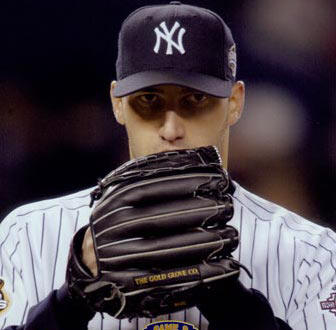
But I believed every word that Andy Pettite said during an hour-long press conference Monday afternoon.

First off, Pettite should be commended for dedicating 60 minutes to mostly answering questions about his use of Human Growth Hormone. Name me another athlete with Pettite's profile who has done something remotely similar.

Secondly, Pettite obviously isn't a well-versed public speaker. It was reported that his hands were shaking as he read his three-minute prepared statement. Several times throughout the session, he admitted to not knowing the answer to a question or asked a reporter for a fact or to clarify a fact.

When asked what he thought of Roger Clemens saying he "misremembered" the conversation from which Pettite said Clemens told him about his use of HGH, Pettite said simply that he spoke under oath and "so did Roger."

That is true. I can't imagine the Pettite I saw in front of the microphone lying under oath. Clemens, on the other hand? Yes, I could definitely see him being deceiving.

Pettite's words were not an act on Monday. They were the words of a man who clearly wants to put this whole episode behind him. They were the words of a contrite individual.

Pettite talked at length about the reasons why he took HGH in the first place. But he didn't give the typical response to a query about why he did it. Unlike, say, Barry Bonds, Pettite didn't say, "I didn't know what I was injecting into my body." Rather, Pettite told the throng of reporters that he thought he was prolonging his career when he made the decision.

It was almost impossible not to believe what Pettite was saying.

Clearly, Pettite's memory is not the best. He didn't remember when he signed his one-year, $16 million contract, which was actually a week before the Mitchell Report came out. When a reporter wrongly suggested that the contract was signed a day before the report, Pettite didn't disagree.

So could it be possible that Pettite really "misremembered" that conversation from 1998?

I don't think so. That type of information isn't something that people forget. That definitely is something that comes straight to the front of the mind when you're under oath. Pettite wouldn't have disclosed that information if he was unsure about what was actually said.

My belief in Pettite has nothing to do with his strong dedication to religion. We all know how religion can be twisted by some of this country's dirtiest people. Rather, Pettite's body language, humbled attitude and open answers convinced me that he was telling the truth. He had nothing to hide.

In today's environment of athletes who "only want to talk about baseball," who refuse to answer the important question, Pettite's Q&A session was refreshing.

One, because he was believable, and two because the situation was unbelievable.

I'd never seen anything like it before.

Thursday, February 14, 2008

The case is just about closed on Clemens, Bonds

ON BASEBALL

Yes, both are lingering stories. Yes, Roger Clemens and Barry Bonds will remain in the news for at least a year or two.

There will be more hearings, maybe a couple trials — and if we're lucky enough, a conviction or two. But that's about as likely as me refusing my S.I. Swimsuit issue.

Bonds' perjury trial and Clemens' battle with Brian McNamee are what we in the media like to call "ongoing." As far as I'm concerned, however, they're closed cases.

I've made up my mind about the two former baseball stars. I highly doubt I'll change my opinion.

Here it is:

Both — regardless of what they injected, swallowed, rubbed — were great baseball players. Both created Hall-of-Fame resumes before they allegedly took the "stuff."

Both also are extremely arrogant, proud men — check that, jerks — who refuse to admit the truth no matter how daunting the evidence against them becomes. I'm 99.999999 percent sure Bonds was doping. (I trust the two San Francisco writers; what would they have to gain by writing an entire book full of lies? They almost went to jail for it.) I'm 95 percent sure Clemens was doping (why would his teammate and friend Andy Pettite — a God-rearing man — lie about Clemens' use?).

I'm not going to get deep into the pile of evidence against both players. By now, I'm sure, you're as sick of hearing about it as I am.

What I will say is that the majority of the public has placed an asterisk next to the careers of the two, big-headed players. And that, really, is all that matters.

Neither player is likely to play another game in the major leagues. All that matters now are their legacies, and the general public has painted a pretty clear picture in that regard.

Most baseball fans think Clemens and Bonds are full of ... well, you know.

In an ESPN.com poll, 67 percent of voters believed McNamee — not the cleanest guy, I remind you — over Clemens. Think if McNamee was a decent, law-abiding citizen. It would have been 85-15. Not even Texans believe their home-state hero (or past hero?). About 63 percent of voters from the Lone Star State believed McNamee over Clemens.

The one thing Clemens got right during the hearing Wednesday is that he'll never be viewed in the same light as before his name appeared in the Mitchell Report. That would be correct.

As crazy as this sounds, Bonds — despite his obvious guilt and gigantic noggin — might end up having more believers than Clemens. There are a couple reasons for this. First off, the majority of Giants fans still love Bonds and are willing to overlook his transgressions — although most of them aren't naive enough to think he didn't take anything. Secondly, in the last poll I saw, the majority of the black population still supported him.

Who would have thought two years ago — or even last July — that Clemens might surpass Bonds as America's most despised baseball player? Now, it's possible.

And it really is all that matters — how the public views both players.

Of course, there will be plenty of debate in terms of their HOF resumes. Baseball writers will argue long and hard about whether they belong in the sacred shrine of Cooperstown. Plenty of media coverage will be given to those proceedings.

But even if Clemens and Bonds becomes members of the Hall of Fame, that won't change the opinion of all us baseball fans who know — or are at least fairly sure — they cheated to achieve some of their success and set their amazing records.

As long as we educate the following generations about the tainted legacies of Clemens and Bonds, they'll never — as Clemens said — be solely viewed as great baseball players by the majority of baseball enthusiasts.

They'll be remembered as all-time greats who cheated.

As much as I'd like to see the truth forced out of them, I'm not holding my breath.

How they're viewed by this country's baseball fans is a good enough punishment.

Monday, February 11, 2008

We can only wait and see with Shaq

ON BASKETBALL

Plenty of people have opinions on last week's trade of Shaquille O'Neal from Miami to Phoenix for Shawn Marion and Marcus Banks.

My friend Cosey — as well as thousands of other hoops fans — think O'Neal is washed up and won't be of much use to the Suns. In other words, he won't win that elusive championship for Steve Nash n' Co.

ESPN.com columnist Scoop Jackson — and thousands of others, but not as many thousands — think O'Neal is the key ingredient the Suns have been lacking the past few years. They point to his defensive presence. They say Marion and big man Amare Stoudemire quarreled too much. They agree with the trade.

The truth?

We don't know and we won't know for quite a while.

O'Neal hasn't played since mid-January with a hip injury. He's back to working out, but will he be able to stay healthy? There remain two months of regular-season play plus that nearly-two-month playoff circus. That's almost four months. Can O'Neal endure that?

How will he fit in the Suns' run-n'-gun system? Some analysts have said that the older you get, the easier it is to run north-south as opposed to making quick, lateral movements. But don't tell me O'Neal's gonna run the fast-break quick enough to receive a dime from Nash ahead of the defense.

That's one thing I don't see happening.

But here's something Phoenix can look forward to with O'Neal. If, indeed, he is healthy come playoff time, he'll be valuable in half-court sets — and the action tends to slow down late in the season. Say what you want to about O'Neal, but he still draws double-teams and remains a deft passer out of the post. When possessions are breaking down, O'Neal will be a viable option (again, if he's healthy).

The defensive end is where O'Neal could be most valuable. Stoudemire has not developed into the defensive force Phoenix fans hoped he would. He shows flashes of solid play here and there, but he can't consistently thwart players such as Tim Duncan and Carlos Boozer.

When Stoudemire and O'Neal are both in the game, Stoudemire will be able to play power forward and leave the toughest defensive assignment to O'Neal. Call O'Neal immobile if you'd like, but ask any NBA player who he's most intimidated by — and I bet Shaq's still near the top of the list.

But forget X's and O's. The biggest question mark of thousands is whether O'Neal will be on the court enough to make a solid impact. I'd say he needs to play a good 20 minutes a night for the Suns to survive the Western Conference and make the NBA Finals.

On Monday, after his first practice, he admitted that he was a bit winded running up and down the court with the Suns. But in O'Neal's defense, he had been completely sidelined for three weeks.

A good thing for the Suns is the timing of the deal. O'Neal is rested. The team has the West's best record and doesn't need to rush him back into action. If O'Neal plays, say, the Suns' final 25 games (they're 36-15), he should be in good form — but not too fatigued — heading into the playoffs.

That's what has made O'Neal effective in the past. He'd miss the first half of the season with some injury — or lazy syndrome — and then roar into April with a full head of steam. While I don't foresee any roaring from O'Neal, if he has half a head of steam, the Suns will be in good shape.

Of course, even if O'Neal plays well, that doesn't guarantee anything in the mighty West. San Antonio remains the team to beat in the playoffs. The Lakers will be scary if Andrew Bynum comes back strong. And don't forget about Dallas, Utah and even New Orleans (oh, and always-dangerous Golden State).

It is clear that this year more than ever, winning the NBA's superior conference will be as exhausting as a trip up Mt. Everest (before the days of billionaires paying guides to drag them up the mountain). Games will be slug-fests. Series sweeps will be minimal.

By May, O'Neal might wish he were back in the "Leastern Conference."

Or he might be having the time of his career helping the Suns finally reach their goal.

You can guess all you want. All we know right now is ... well ... nothing.

Show us what you can do, big fella!

Thursday, February 7, 2008

Duke's balance, 3s down Carolina

ON COLLEGE BASKETBALL

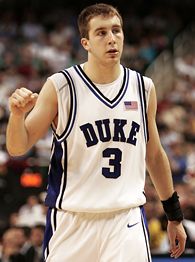
Memo to North Carolina fans: Maybe if you stopped hating Greg Paulus so much, he'd stop playing so well.

Paulus, a former high school stud quarterback, has reveled in being at the center of things this season, and Wednesday night was no different. Duke's point guard lit up the Dean Smith Center for 18 points on 6-for-8 shooting from 3-point range. Thursday morning, sitting in a room full of UNC fans, everyone talked of how they absolutely can't stand Paulus.

But they could have used him on their team Wednesday. Most of Paulus' 3s were contested, but the 6-foot-1 guard has a quick release and was able to get his shot off over contesting defenders.

UNC didn't play terrible, it was just out-manned. Tyler Hansbrough could only do so much.

And that's why, at this point in the season, Duke is a slightly better team. The Blue Devils simply have more scoring options — and you never know who's going to pour in 20 on a particular night.

On Wednesday, it was everybody, as six Devils scored in double figures. Additionally, five Devils knocked down at least one 3-pointer.

How do you stop Duke's attack? You hope the Devils have a bad shooting night from behind the arc like they did in their lone loss to Pittsburgh. When Paulus made a 3 less than 20 seconds into the game, I got the feeling it was going to be a good shooting night for the Devils, which was bad news for the Tar Heels.

If you check out the box score, UNC made just two less field goals than Duke (30 to 28) and made three more free throws (19 to 16) — numbers that would equate to a one-point Duke win if the 3-point shot didn't exist.

The arc killed the Heels Wednesday night. While Duke made 13 of 29 long-range bombs, UNC managed to hit just three of 17.

I wasn't surprised. Not only do the Devils shoot the 3 well, they also defend it extremely well. In all eight of its ACC games, Duke has not allowed a team to make more than four 3s, and its opponents have shot a combined 28-of-101 (28 percent) from downtown.

Duke haters might call that luck, but the truth is that the Devils are willing to give up the occasional easy inside shot as long as they don't surrender the open 3. In college basketball, nothing swings momentum like a made 3-pointer — especially back-to-back 3s. Only once did the Heels have the momentum — when they ended the first half on an 8-0 run to pull within 42-39. But the momentum was gone in the second half, and Duke gradually built its lead en route to the 89-78 win.

While Hansbrough gave another workmanlike effort with 28 points and 18 rebounds, he didn't get the perimeter help he needed. Duke was all over UNC's top outside shooter, Wayne Ellington, forcing him into a miserable 3-for-14 shooting performance, including zero makes out of six 3-point attempts. Sixth man Danny Green was even more off, not scoring until he hit a late 3 and finishing 1-for-10 from the field.

Obviously, the Heels missed point guard Ty Lawson, whose ankle didn't feel great before the game, causing Roy Williams to tell him to sit out. The Heels weren't able to get out on the fast-break with Lawson sidelined, and Lawson has also improved his outside shot this season. Assuming a full recovery, Duke-Carolina Part II should be very intriguing come early March.

But what happened, happened. And I'm not even sure Lawson would have made a huge difference. The Devils' system is predicated on running, so I don't think UNC would have wanted to get into a track meet.

As it was, Duke thrived in the half-court because of its ability to shoot the 3. When Kyle Singler sets a pick out top for Paulus, it's almost impossible to guard. Here's why: If Singler's man doesn't hedge on Paulus, the point guard will quickly pull up for an open 3. If he does hedge, Singler is usually pops open for a 3 — and for a 6-8 guy, he can shoot it from outside.

Singler's and Paulus' 3s a minute apart late in the second half helped to keep Duke's lead at nine, and UNC didn't get much closer until the final minute when it was too late.

The good thing for the Heels is it's only early February. In retrospect, Wednesday's result won't matter come the big games in March. By then, Lawson will likely be healthy and the Heels will be an improved team on both ends of the floor.

The good thing for the Devils is they're on a roll right now and they're showing no signs of letting up. All season long, they've been doubted because of their lack of an inside presence. But will anyone remember that they were out-rebounded by 11 (49-38) Wednesday? Maybe Mike Krzyzewski and his staff in preparing them for future games, but nobody else.

The truth is that the Devils have the players to win a national title. Their leader, DeMarcus Nelson, had a poor game Wednesday, making a mere three of nine shots to score 13 points and playing just 23 foul-plagued minutes. If Hansbrough — easily UNC's most important player — had scored below his average or been in foul trouble, the Heels would have lost by a lot more than 11.

These teams are still very evenly matched, and there remains a chance Duke could stumble before the rematch March 8, giving UNC a chance to snare a share of the ACC title when the teams face off inside Cameron Indoor Stadium.

But for now, the national rankings have got it right: Duke is No. 2 and UNC is No. 3.

Wednesday, February 6, 2008

No, I'm not watching signing day

ON COLLEGE FOOTBALL

Listen, I love sports as much — and probably even more — as the next guy. Heck, I'll watch a closely contested Rutgers-St. John's matchup over "American Idol."

But I refuse to watch or pay much attention to this media-created phenomenon called "National Signing Day."

And that's coming from a Michigan guy.

No, I don't have my fingers crossed that Terrelle Pryor — who's apparently in Rich Rodriguez's "Fave Five" — will sign with the Wolverines. And, no, I won't jump off my third-story apartment building's balcony if he becomes a Buckeye.

Sorry, but I'm reserving those emotions/bad decisions for the actual college football season, when Pryor might actually play in a college game. Until then, he's just another high school kid who gets way too much attention and probably has a blown-up head because of it.

Letting 17- and 18-year-olds declare their college choices on national TV is one of society's many problems (alongside, you know, poverty, the economy, pollution, etc.). Put yourself in the kid's shoes for a second.

There you are, surrounded by a throng of people sticking out microphones and recording devices in your face. To your right are all your supporters — or people who want some of your money once, as you all believe, you go pro. To your left is your coach, who hopes to get a higher-paying job or at least a raise out of this.

And I didn't even mention the cheerleaders.

I'm not in denial. I know this is the way our over-hyped society works now. I'm just throwing out a caution flag.

Perhaps, in two years, a Florida or Notre Dame will be able to look back at this day and say, "That day is when we built this national title. When 'Joe Schmo' and 'Bill Dill' put on our hat, we instantly became national title contenders."

But no matter who signs where today or in the days to come, the worth of the Class of 2008 won't be determined until at the very earliest September and possibly not until the fall of '09 or 2010. I've never played tackle football — except during recess back in eighth grade — but I've heard whispers that the college game is a bit faster and a bit more complicated than the competition at the high school level.

By all means, correct me if I'm wrong.

So as good as Pryor is, as mesmerizing as his YouTube video is, hold the phone on calling him a future All-American. Michigan fans, you're not competing for the national title next season regardless of which state Pryor plays football in. Ohio State fans, you'd be best suited to stay far away from the national title game — just throwing that out there.

National Signing Day is the second-most over-hyped day in American sports behind — you guessed it — the NFL Draft. Buildup to the draft is absolutely ridiculous. It's a bunch of former NFL players guessing who will be good in the NFL and for what teams college studs will play for. Stay tuned for my "No, I'm not watching 10 straight hours of NFL draft coverage" column coming in April.

For now, however, I think I'll enjoy a beautiful day here in Chapel Hill and leave the TV off until Duke-UNC tonight. Yep, that's right — actual college athletes competing against each other on national TV.

That's something I don't have a problem with.

Monday, February 4, 2008

Giants play small ball to slay mighty Patriots

ON FOOTBALL

The New York Giants, those guys who took down the heavily favored Patriots Sunday, remind me of a baseball team.

I know it sounds weird — the two sports don't have too many similarities — but when trying to put New York's championship in perspective, the 2005 Chicago White Sox come to mind.

A team no one expected to challenge for the peak of its sport's success prior to the playoffs.

A team that didn't light up the scoreboard, but did enough to win.

A team that didn't make "SportsCenter" plays, necessarily, but the little plays that coaches/managers notice.

A team with recognizable names, but not that one star, that stud with the famous girlfriend.

OK, I'll stop there. Comparing baseball to football isn't easy (and I don't advise you to try it), but the White Sox's bunting, run-producing offense and stellar pitching of three years ago is what I thought of as I watched from my couch Sunday night.

It started with the Giants' opening drive. As they set records for first downs made on the first drive of a Super Bowl and for the time of a possession (almost 10 minutes), I realized how they could pull off the monumental upset.

It wouldn't be easy, but they needed to run the clock as much as possible on offense, keeping Tom Brady on the sideline until his feet fell asleep. They needed to sustain drives and then make New England's offense do likewise. The Patriots were going to score — no one would doubt that — but if the Giants could make them march up and down the field, more time would run off the clock and there'd always be the chance of a turnover happening or a drive-halting penalty or sack.

Just keep the game close, I thought to myself. Shorten the game as much as possible and stay within a score, and the Giants had a chance.

And that's exactly what they did. In fact, they executed so well, they were able to get away with a few mistakes — most notably Eli Manning's interception deep in New England territory in the second quarter.

Just like the White Sox's improbable run to the World Series title began and ended with great pitching, the Giants' victory Sunday was all about defense. During the week, Brady laughed at New York wide receiver Plaxico Burress' suggestion that New York would win 23-17.

"We're only going to score 17 points?" Brady laughed. "OK. Is Plax playing defense?"

Burress wasn't on defense, but Justin Tuck and his fellow linemen were. You've heard the numbers by now, but the bottom line is that the Giants pressured Brady the entire game, never letting him get into the type of rhythm he's accustomed to.

When the Patriots go the ball back with 35 seconds remaining and all three timeouts, I predicted overtime. I certainly didn't forecast Jay Alford — I thought the Alfords were basketball people? — recording his lone sack of the game on second down, which was the play that essentially cemented the 2007-08 Patriots' first loss.

But that's exactly what happened. And when Brady fired deep balls to Randy Moss on the final two plays, both times they were broken up. No spectacular interception was needed. No fumble recovery. Just a big-time sack and a pair of breakups. That's how the Giants won.

Of course, similar to the White Sox's Scott Podsednik — the smallest, scrawniest guy on the team — hitting a walk-off home run in Game 2 of the World Series, the Giants got a big play from an unexpected hero.

My guess is that about 9.6 percent of the large television audience knew who David Tyree was prior to the fourth quarter Sunday, but with his first touchdown of the season — in the Giants' 20th game, for crying out loud — and then the play of the game, Tyree cemented his legacy even if he quits playing football on Thursday.

The Giants faced a 3rd-and-5 at their own 44-yard line with just over a minute to play. Manning dropped back and was immediately under immense pressure from every Patriots player in his vicinity. By someone's grace, however — maybe it was brother Peyton in the luxury suite who gave Eli special power for one play — Manning escaped the pressure and launched a pass about 35 yards in the air.

Watching Manning release the ball, I thought the pigskin was en route to the stomach of a Patriots defender. It seemed like the kind of rushed, off-balance throw down field that is destined for trouble.

But then Tyree made the catch of his life, leaping to not only out-muscle New England safety — and former HGH user — Rodney Harrison for the ball, but to hang onto it in his outstretched hands as he and Harrison hit the ground.

Again, I couldn't believe what I was seeing. Initially, I was convinced the ball must have hit the turf. But no challenge was needed. It was a clear catch, just like Podsednik's clear home run, and it gave me the feeling that maybe — just maybe — Sunday night was a Giants night.

You know the story from there. Another unheralded receiver, rookie Steve Smith, keeps his feet in bounds to pick up a first down on 3rd-and-11, and on the very next play, Manning finds a wide-open Burress on the fade route for the go-ahead score.

After the defense finished the job, it was celebration time.

Before the game, I thought the Patriots were the better team, and I still believe that's the case. I would pick them to win seven out of 10 games against the Giants.

But that's the beauty of the playoffs, of the winner-of-one-game-takes-all scenario. On Sunday, the Giants were the best team on the field. The Patriots, as gracious in defeat as I've ever seen them (minus, of course, Bill Belichick), admitted as much. They didn't so much lose the game as the Giants won it.

There's no doubt about it.

You can always point to a play and say, "If only this had happened..." Today, I'm sure, Patriots fans are lamenting Brady's second-to-last throw, when if he could have chucked the ball 5 yards farther, Moss might have separated himself from the defenders and scored a miracle touchdown.

As good as the Manning-to-Tyree connection was — it's already a frontrunner in the "Greatest play in a Super Bowl" debate — the Giants' victory wasn't decided by one play. The game was not a sprint but rather a marathon. What happened between Jordan Sparks' protracted national anthem and Belichick's early departure from the field resulted in 17-14 Giants.

Not a bad guess at all, Plax. Guess your defense backed you up.

Now if only Jermaine Dye had predicted a sweep of the Astros in '05, my argument might be stronger.
Friday, February 1, 2008

Plenty of questions surround improved Lakers

ON BASKETBALL

No, the Lakers are not the "team to beat" in the Western Conference.

Are you kidding me? Some analysts actually believe L.A. — not the Spurs, Suns, Mavericks, Jazz or Hornets — is now the best team in the NBA's elite conference. They're overreacting.

Don't get me wrong. L.A.'s move to acquire Pao Gasol Friday instantly made the Lakers better. I wrote on Christmas that the Lakers are contenders in the West. Now, they're definitely contenders.

But the best team in the West? Well, let's see how Gasol fits into their system.

For now, Gasol will start at center with Lamar Odom playing his normal power forward position, but when star-in-the-making Andrew Bynum returns in March, what will Phil Jackson do with his starting lineup?

He'll almost undoubtedly start his twin towers, Bynum and Gasol, but what about the 6-foot-10 Odom? Will he be moved to small forward? Anyone who watched Odom air-ball a long jumper at the end of L.A.'s loss to Detroit Thursday night knows that he's not comfortable on the perimeter. Odom is shooting 23 percent from downtown this season.

If Jackson goes with Odom, L.A.'s lineup would feature just two players capable of making outside shots — Kobe Bryant (yeah, he's pretty good) and point guard Derek Fisher. Defenses could sag against the other guys, making them knock down 20-footers. Gasol is a decent mid-range shooter, but you don't see teams running out to prevent him from shooting J's.

Much of the Lakers' success will depend on how well Gasol shoots those jumpers. I believe Jackson will place him in the high post once Bynum returns, giving Bynum plenty of room to operate down low. If Gasol can't make 15-footers, he will be an ineffective offensive player.

And, again, what will Odom's role be? Now is the time for Jackson to demonstrate why he's won nine NBA titles. He's got the pieces, he just needs to figure out how to solve the puzzle in front of him.

One thing this move does — undoubtedly — is keep Bryant in L.A. for at least the remainder of his contract and very possibly for the remainder of his career. Gasol, 27, will probably play as many seasons as Bryant does. And he's got Bynum and improving guard Jordan Farmar for several more years.

There will be no more trade requests from Bryant. As he said Friday, "Now it's time to walk the walk."

The pieces are in place.

Meanwhile, no key players were lost. While past trade offers for the likes of Jason Kidd or Jermaine O'Neal — both much older players than Gasol — would have meant giving up Bynum, Odom or both, Mitch Kupchak must have felt relieved to dispose of Kwame Brown's $9-plus million contract.

Javaris Crittenton was another promising point guard, but no better than Farmar and much more inexperienced. We don't know what will happen with Gasol's younger brother, Marc, but it's clear that he's a project. The 2008 and 2010 first-round picks L.A. relinquished will likely be lower picks.

Really, nothing was lost. Now, there are no excuses. It's time for the Lakers to show what they're made of.

Friday's move came off as a bit panicky. L.A. had slipped of late, losing four of five games entering Friday night's game in Toronto. It was transparent that LWB (Life Without Bynum) was taking its toll on the team. So the Lakers acting quickly, making a move that instantly improves them but creates plenty of questions.

Maybe this is part of a grander plan. Perhaps Odom is on his way out of L.A. Could the Lakers still be trying to acquire Kidd?

There remain several unknowns, but one thing can't be disputed: If Gasol plays like the All-Star and Rookie of the Year he's been, the Lakers will be one of the top teams in the top-heavy West.

But the favorite to make the NBA Finals?

Let's not get ahead of ourselves, folks. He's not Wilt Chamberlain.