Monday, February 7, 2011

Wolverines have long way to go, but mental toughness improving

ON BASKETBALL

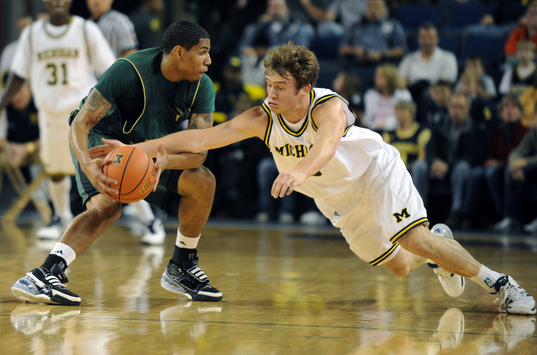
This Michigan basketball team's season is likely headed toward a conclusion that many of recent memory have met — the Not Invited Tournament.

It's fun and spine-tingling to talk NCAA Tournament this time of year, and at 14-10 and 4-7 in the Big Ten — with a trio of solid road wins (although beating suddenly pitiful MSU looks worse and worse by the day) — the Wolverines are a strong finish away from entering the bubble conversation.

But for now, the more realistic topic to discuss should be just how much this young team has grown. Sunday's win at bubblicious Penn State was a perfect example. Used to be, when the Wolverines fell down double digits on the road, it was game over. They lacked the fight, the toughness, the savvy to turn things around in hostile environments.

On Sunday, however, this group overcame not one, but two double-digit deficits. They didn't wake up until about 12:30 and found themselves, somehow, only down 11 points. A transition-fueled 14-0 run later, they were up three heading into halftime. They stuck to the pattern in the second half, looking lifeless in quickly falling down 10. But back they came, again, led by the inspired play of freshman Tim Hardaway Jr., whose facial expressions told the casual viewer, "I am not losing this game."

Final score: Michigan 65, Penn State 62.

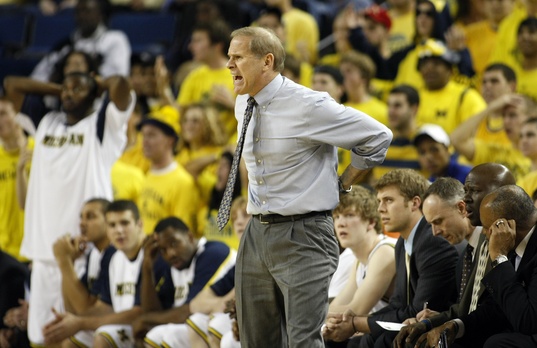
"I think it's experience, just that we've been in these situations a little bit," coach John Beilein said. "They know now that first of all, it's not over when you go down nine (or 10 points).

"You can get back in a game very quickly."

A month ago, this concept seemed asinine when it came to this group of youngsters. Playing at Wisconsin in early January, the Wolverines put together a tough first half and led 28-26 at the break. However, when they quickly lost the lead early in the second half, I had no doubt that the advantage wouldn't change hands again. The Badgers, especially at home, were too tough.


That started a six-game losing streak, which included the Wolverines' two most distressing games of the year — uncompetitive road losses at middle-of-the-pack Big Ten teams Indiana and Northwestern. In the pair of L's, Michigan seemed lost on defense, unable to provide any resistance as the Hoosiers and Wildcats ran roughshod over them.


Many Michigan fans were ready to chalk up the season as a lost cause, and some were even calling for Beilein's head.


But then came the inspired effort at the Breslin Center — it's amazing what a rivalry can do — during which ESPN's cameras captured a red-faced Zack Novak yelling at his teammates in a huddle. Not only did the Wolverines want the game more than the Spartans, they proved it with grittiness on the court.


With two wins in their three games since, and the only loss at undefeated No. 1 Ohio State, the Wolverines have retained the momentum created by their first win in East Lansing in 14 years And now they get a second shot against the Hoosiers and Wildcats at home. 


"To a degree, it's not as foreign as it was when all these kids walked on a away court for the first time," Beilein said of winning away from Crisler Arena.


Michigan hasn't found a secret formula, but they've become a much more confident lot that doesn't get flustered when the lead is lost and the crowd is in a frenzy. Darius Morris runs the point with aplomb. Veterans Stu Douglass and Zack Novak hit the big 3s. And in perhaps the most positive individual development, Hardaway showed on Sunday that he's not afraid to be assertive in crucial situations.

After riding the bench with foul trouble  the first 33 minutes, Hardaway made up for lost time with all 13 of his points in the final seven and a half minutes. He found Douglass for a 3 then drained  consecutive contested 3s from the wing to knot the score at 53; Morris put the Wolverines ahead for good just moments later.

"We're trying to find new ways to get him involved," Beilein said of Hardaway, who continued his offensive explosion by finding Jordan Morgan off a pick-and-roll for a thunderous dunk and then made a layup on the next possession to push Michigan's lead to five with 1 minute, 39 seconds left. That was, just about, all she wrote.

These are good signs. Of course, they shouldn't entirely overshadow the ugly, which is that at times the Wolverines look completely out of sorts on offense (example: the first 10 minutes Sunday) and still struggle on the defensive end.

And, no, this isn't an NCAA Tournament team. They would need at least a 5-2 record the rest of the way and a pair of wins in the Big Ten tournament to reach the Dance. I don't see that happening.

The Wolverines, though, are making strides. Perhaps most significantly, a road deficit no longer automatically equates to a road loss.

In other words, hold that clicker steady. You don't want to miss another Michigan comeback.

Sunday, January 30, 2011

Having matured, Djokovic proves himself as legitimate threat to the Big Two

ON TENNIS

After cruising by Andy Murray Sunday night at the Australian Open, Novak Djokovic grasped the championship trophy for the second time — exactly three years after he won his first grand slam tournament.

In between, there have been many disappointments, a few close calls — especially his loss in the championship match of last year's US Open to red-hot Rafael Nadal — and a slew of frustrating injuries. Lost in all the negatives, however, is just how much better the Serbian has become.

His serve's a little better. He has refined his groundstrokes. Most importantly, though, Djokovic has become mentally strong — a trait that, until now, separated Nadal and Roger Federer from the rest of the world's players even if they were just as physically talented.

It used to be, Djokovic would become frustrated and angered quickly, yelling at his racket and staring at his player's box after consecutive poor shots. Such reactions rarely led to improved play. Meanwhile, on the other side of the net, Federer or Nadal coolly picked the youngster apart.

Game. Set. Match.

In Sunday's three-set victory, it was Murray, the young British hope, who was talking to his racket and who let a break toward the end of the opening set seemingly affect him poorly during the following less competitive sets. Djokovic, like an experienced champion, took advantage of Murray's fragile mental state.

Is his game better than Murray's? Perhaps slightly — he hits his forehand down the line better. But it's not three-sets-to-love better. Mentally, he's light years ahead of the world's No. 4-ranked player.

Djokovic knows just how far he's come since that first Grand Slam title, when he was having all kinds of fun — and got plenty of enjoyment out of mimicking other players — but was far from a complete player.

"I feel like a better player now than I was three years ago, because I think that physically I'm stronger, faster, mentally I'm more motivated on the court," Djokovic said. "I know how to react in certain moments, and I know how to play on a big stage. I have been more focused and dedicated to the sport than I have ever been before."

And now, with Federer edging toward 30, Djokovic clearly has the chance to move into the world's No. 2 spot and be a legitimate threat to win every major — even if he has to go through both Federer and Nadal (something he still hasn't done at a major).

In Djokovic's three-set victory over Federer in the semifinals, he was, quite simply, the better player. In past matches, he was just as good physically but didn't win the big points, didn't execute shots when he absolutely needed to. That's changed now.

Not only is Djokovic as talented as any player in the game; he's as mentally tough, too. Now the question is, Can he bring the same package to every tournament, especially the big ones?

Only time will tell. As for Murray, Sunday illustrated that he's still where Djokovic was at least three years ago. And only time will tell if he can make the same transformation.

Sunday, January 2, 2011

Novak shows leadership, shooting touch in Wolverines' win


ON BASKETBALL

With his team clinging to a precarious one-point lead, Zack Novak didn’t hesitate to step into the biggest shot of his best half of basketball this season.

Novak, who struggled to knock down open shots during the 2010 portion of this season, nailed a 3-pointer from the top of the key Sunday afternoon to help Michigan pull away from Penn State for a 76-69 win.

It was a much-needed victory for the Wolverines (11-3, 1-1), who couldn’t afford to lose their first two Big Ten games — both at home — with their next three games at Wisconsin, and back at Crisler Arena versus No. 3 Kansas and No. 2 Ohio State.

Brutal.

As good as Darius Morris was against the Nittany Lions (8-5, 1-1), accumulating 20 points and 10 assists for his fifth double-double of the season, we’ve come to expect that from him. What the season’s first 13 games hadn’t indicated was what Novak, the junior, provided — and Michigan needed — in Sunday’s final 20 minutes.

Novak scored all 15 of his points on 5-of-6 shooting and grabbed all four of his rebounds after intermission. He entered he game shooting 33 percent on the season — yes, brutal — but finally found his stroke, making two 3-pointers and adding a pair of transition layups on which he simply outhustled everyone else on the court.

“That really felt good (for him). You could see the smile on his face,” coach John Beilein said of his upperclassman. “He’s such a leader on this team.”

Until Sunday, for the most part, he was a leader whose impact hadn’t been felt. Going forward, Michigan will need more such performances.

As one of the Wolverines’ best defenders and rebounders, it’s important for Novak to be on the floor. But prior to Sunday, he had almost been an offensive liability, allowing defenses to focus more attention on Morris and Douglass, who has been the Wolverines’ most consistent outside threat (45 percent from deep).

If Novak is nailing open shots like he did against Penn State as well as pump-faking and driving — as he, Douglass and Matt Vogrich all did Sunday — it takes some pressure off Morris and makes the Wolverines that much more difficult to guard.

Which, in turn, leads to works of efficacy like Sunday’s second half, during which Michigan outscored Penn State 45-33 and shot 60.9 percent.

“To score what we did in the second half is great for us because as we develop our defense, we’re going to have to score points,” Beilein said.

And he’s right. Michigan’s defense was not great Sunday, but a lot of that had to do with facing a great offensive threat in Taylor Battle (31 points). Battle hit an array of difficult shots, and the Wolverines’ youth also showed through a slew of ticky-tack fouls on the perimeter that put the Nittany Lions in the bonus early.

“We need to do extra conditioning to keep from hand-checking,” Beilein said.

That’s especially the case with talents such as Jared Sullinger and Kansas’ Morris twins on the upcoming schedule.

But Sunday was a big step in the right direction for the Wolverines. And Zack Novak had a lot do with that — on both ends of the court.

Thursday, December 30, 2010

In brutal Big Ten, defense will make or break Wolverines

ON BASKETBALL

Despite most people saying that Purdue dominated the entire second half of its 80-57 thrashing-that-wasn't-a-thrashing-until-the-other-team-quit over Michigan Tuesday in the teams' Big Ten opener, the truth is that the Wolverines played the Boilers fairly even for the first 12 minutes of the half.

Then coach John Beilein made his biggest blunder, calling timeout with the Wolverines trailing just 57-49 — four points worse than their 30-26 halftime deficit — and putting his team in its shaky 1-3-1 zone.

Seconds later, Ryne Smith found himself wide, wide open on the right wing and proceeded, quite casually, to knock down his fifth 3-pointer in six tries.

Purdue led by 11. Michigan's effort slacked off. And the game, just like that, was over.

Afterward, Beilein wasn't asked about his decision to go to the zone. After a 23-point defeat, that might have seemed like too pointed a question. After all, it was one lousy possession of many on which the Boilers got what they wanted offensively.

Rather, the best question asked was about how to get a  young team like the Wolverines to remain focused on both ends of the floor.


"It’s pretty difficult to go from one end of the floor to the other," Beilein said. And then he repeated himself: "It’s hard to do that. It’s hard to focus both ways for our team."


Of course, he's right.

If the Wolverines (10-3) are going to put together a respectable Big Ten record, they're going to need to meet that challenge and compete for 40 minutes on both ends. On Tuesday, they put together about 15-16 good 94-feet minutes.

But doing that starts on one end for this group — the defensive end.

Why? Because when the Wolverines play good defense, it will usually translate — against tough, defensive-minded foes like Purdue — into easier offense.

Against the Boilers, Michigan looked lost and scared in its halfcourt offense against Purdue's set D. Even with Darius Morris running the show, the Wolverines often found themselves out near midcourt with the shot clock nearing expiration, forced to make a last-ditch effort at a decent shot.

And each time Purdue scored on the other end, it meant another halfcourt possession for the Wolverines — not to mention a larger deficit to think about (Michigan led just once, for 10 seconds, 26-25).

On the other hand, the Wolverines were most effective on the offensive end after a missed shot or turnover by the Boilers. While they didn't get many fast-break opportunities, they scored the majority of their buckets during a 19-4 first-half run on the secondary break, as Morris created open looks for teammates before Purdue's defenders got set.

During Michigan's best stretch, Stu Douglass and Evan Smotrycz each drilled a pair of open, in-rhythm 3s, Douglas made a layup against an unsettled Purdue defense and Jon Horford got a transition dunk to give the Wolverines that short-lived lead.

It all started with stops and forced turnovers on the other end.

Beilein saw things the other way around, saying, "We had some really bad lulls offensively, which really led to some bad defense."

Which, of course, is true. But getting stops on the defensive end, especially during a second half in which Purdue shot 63.3 percent, might have, in turn, created better offensive opportunities for the Wolverines.

Michigan managed to almost keep pace for those first 12 minutes, and during that timeout I thought the game was far from over. But after that horrible defensive possession — Beilein was desperate for a stop so he tried to switch things up; the players weren't ready for it — the Wolverines didn't have enough gas and resolve left to continue trading barbs with one of the Big Ten's best.

They'll get a short reprieve, if you can call it that, with another home game against Penn State Saturday. It's a must-win on a daunting schedule that is followed by a game at Wisconsin — I can't remember the last time they won there — and a nice non-conference break contest at Crisler against, oh, No. 3 Kansas.

To survive such a haunting schedule, the Wolverines need to be much better on defense. Do that, and those offensive lulls might just take care of themselves.

Saturday, December 18, 2010

Led by Morris, young Wolverines a pleasant suprise

ON BASKETBALL

You know what's amazing? Let me explain...

It's amazing, to me, that in today's sports world, a player can go from being relatively obscure and uninvolved one year to being an absolutely stud the next. And surprise everyone in doing it.

Coming into this college hoops season, any fan knew that a Harrison Barnes, that a Kyrie Irving, that a Josh Selby would be impact players as freshmen for their respective teams. Everyone knew that a player like Tyler Zeller would be much improved  as long as he stayed out of the training room.

But what did anyone know about Michigan guard Darius Morris?

Last season, I watched the majority of Michigan games, and Morris was never really a factor despite the fact that the Wolverines had a major need at point guard — Morris' natural position. Morris started 19 games, but averaged just 4.4 points and 2.6 assists per outing.

He most often played off Michigan's go-to guys, Manny Harris and DeShawn Sims, taking spot-up jumpers that looked like misses — and were — the second they left his fingertips.

He looked lost. Disengaged. Unassertive.

In other words, the exact opposite of how he looks now. Because of an aggressive, confidant, creating Morris, the Wolverines (9-2) are easily exceeding the canyon-low expectations that were fairly set for them before the seasons.

On Saturday, they cruised by an Oakland team, 6-6, that is playing a murderer's row non-conference schedule and was coming off its biggest win in school history at No. 7 Tennessee.

Morris has breathed new life into these Wolverines, even if the half-full library crowds at Crisler Arena haven't indicated such a positive upswing. Maybe the fans still don't believe. Heck, I didn't believe my eyes the first three times I watched Morris effortlessly lead the Wolverines fastbreak and create something out of nothing with the shot clock winding down.

But I'm a believer now. Darius Morris, averaging 14.9 points, 7.1 assists and 3.5 rebounds per game, is one of the best point guards in an absolutely stacked Big Ten. And these young, overachieving Wolverines will go as far as he takes them.

Morris worked out with John Wall over the summer, and when watching him, you can see similarities to the No. 1 draft pick. No, Morris isn't as explosive, or quick, or (fill in an exceptional skill of Wall's) — but the guard from California now plays with a great amount of confidence, loves to have the ball in his hands, and never shies away from a big shot.

Michigan needed a leader to step up with Harris and Sims gone. Morris hasn't wasted a second in accepting that role.

He's also been the leader of the Wolverines' biggest strength — their defense. He's put ball pressure on each opponent's PG, making it difficult to set up their offense. He's been the catalyst for Michigan's surprisingly good man-to-man D, which has been so effective, John Beilein hasn't even spent much time working on his patented 1-3-1 zone.

These Wolverines have been far from aesthetic. They've gone through some ugly scoring droughts and built mansions out of 3-point bricks. But their defense has kept them in games, and their point guard has ended those droughts.

Is Michigan an NCAA Tournament team? I would be shocked if that happened. But this extremely young outfit is achieving much more than anyone anticipated, and that's all that one can ask for.

They've been led by their biggest surprise of all.

If you haven't learned the name, you will soon.

Darius Morris, the super sophomore.

Sunday, November 21, 2010

2010-11 belated college basketball preview: predicting the 68

Yes, I'm a cheater. I already know that Minnesota and Vanderbilt have quality wins over North Carolina. I've already seen Duke crush three opponents by about 1,437 — and look damn impressive doing it. I've already watched Pitt tough out two games and Ohio State win in the Swamp.

But, still, the college hoops season is extremely young. Which is why I feel it's fair to make my belated predictions for the new Field of 68. Without further ado — and without viewing the scores from tonight's games — my picks:

THE CHAMPIONS (31 teams)
Big East
Pitt: Maybe no team in the country is better and more comfortable at grinding out close wins, and with the ball in Ashton Gibbs' hands, why not? This team is experienced and hungry for a title.

Metro Atlantic
Fairfield: The Stags have improved their win total four years running, and now return four starters. That might just be enough to unseat those Siena Saints.

America East
Vermont: The Catamounts aren't loaded, but often in these smaller conference tournaments, the teams — and coaches — that have been there before prevail.

Atlantic 10
Temple: It's hard to pick against the Owls and their back-to-back conference crowns. Point guard Juan Fernandez returns to lead the way.

Ivy League
Princeton: People are pretty high on Tommy Amaker's crew at Harvard, but the Crimson will really miss Jeremy Lin. That's why I'm taking a flier on the up-and-coming Tigers.

Patriot League
American: Living in DC, I attend every Eagles home game. And this team is stacked. A team returning all of its top players from a year ago adds transfers Troy Brewer (Georgia) and Charles Hinkle (Vandy).
Northeast
Quinnipiac: There are four new coaches implementing new systems in the league, but one player who knows how to win is the conference's POY Justin Rutty.

ACC
Duke: Only injuries could derail this from happening. These Devils are that good; the Tar Heels are still rebuilding; and the Hokies are still learning how to tough-out games they should win.

MEAC
Morgan State: Here's a small conference that could be devoid of drama — again. The Bears have claimed three consecutive titles and return enough talent and experience to make it four.

Big South
Coastal Carolina: They had a phenomenal regular season only to watch — guess who? — Winthrop steal the tournament bid. Not this time. A pair of South Carolina transfers won't let it happen.

CAA
Old Dominion: The Monarchs return all but one key player from the squad that took down Notre Dame in the Big Dance. Yeah, they'll be back.

Southern
Wofford: After coming within a few hairs of taking down Wisconsin in the tournament, Wofford returns four starters and five seniors.

SEC
Florida: The Gators return a starting lineup that features three seniors hungry for some success considering their unmet expectations the past three years. Talented freshmen also are on the scene.

Ohio Valley
Murray State: Easy choice. The Racers return eight contributors from the fun-to-watch outfit that took down Vandy in the Dance and almost snuck by St. Mary's.

Atlantic Sun
Lipscomb: Betcha can't guess who the nation's leading returning scorer is? Heard of Adrian Hodzic? Nope, me neither. But the dude dropped in 22.7 ppg a year ago.

Sun Belt
North Texas: The Mean Green — best name ever, by the way — will make it to the Dance for the third time in five years thanks to double-double machine George Odufuwa (pronounce that!).

Summit
Oakland: Now that the talented Grizzlies finally got a brief taste of NCAA Tournament fever, they really want to return. NBA prospect Keith Benson (17.3 ppg, 10.5 rpg) will make sure of that.

Big Ten
Michigan State: Ohio State's going to present quite the challenge, and Illinois, Purdue and Minnesota will also be tough (and Northwestern!). But the Spartans will emerge from a loaded conference.

Mid-American
Ohio: One of the most entertaining games to watch on the first night of the crazy tournament was Ohio's thrashing of Georgetown. The Bobcats couldn't be stopped. With most of the catalysts back, expect similar results.

Conference USA
Memphis: The young Josh Pastner is quietly assembling a, um, young, loaded squad at Calipari's old stomping grounds. Expect a return to normalcy in the conference.

Horizon
Butler: They'll miss Gordon Hayward, no doubt, but don't think for a second that these Bulldogs will lapse during conference play. Under Brad Stevens, they'll continue to dominate the conference.

Big 12
Kansas State: Sorry, Kansas, but your rivals will be the ones to steal your grasp of the league. I love Jacob Pullen — fear the beard! — and his late-game heroics, and the frontcourt is loaded.

Missouri Valley
Wichita State: The Shockers return all but one key player from a team that came a win away from taking the place of Cinderella Northern Iowa in the Dance.

Southland
Texas State: Anytime you add a Kentucky transfer — A.J. Stewart — to a Southland team, things are usually looking up. Such is the case for Texas State.

SWAC
Jackson State: Despite an injury to preseason player of the year Grant Maxey, the Tigers won the regular-season crown by three games. Now Maxey, plus four other starters, returns. Watch out.

WAC
Utah State: The Aggies are one of the most consistent, and overlooked, programs in the country. Of course, that does happen when you don't play anybody. But within the league, they dominate.

Big Sky
Weber State: The Wildcats, I'm sure, have used the entire offseason to work as hard as possible to forget the sting of blowing a 20-point lead against Montana in the conference title game. No repeat.

Mountain West
San Diego State: I love Steve Fisher's squad, which returns five starters, including double-double guy Kawhi Leonard. The Aztecs could do some damage in the Dance.

Pac-10
Washington: Arizona and Freshman of the Year Derrick Williams are up-and-coming and will be back in the Dance, but the Huskies are clearly the class of the league led by G's Isaiah Thomas and Abdul Gaddy.

Big West
UCSB: The Gauchos have the returning POY (Orlando Johnson) and a dude who had nine 20-point games (James Nunnally). Enough said.

West Coast
Gonzaga: Speaking of enough said, guess who dominates their conference every year? The 'Zags might need to win the conference tournament considering their nonconference war zone: SDSU, Kansas State, Duke/Marquette, Illinois, at Notre Dame, Baylor, Xavier and Oklahoma State. Brutal!

THE AT-LARGE BIDS (37 teams)
*In order of higher-seeded teams

ACC
Virginia Tech
North Carolina
N.C. State
Virginia Tech
Maryland
Miami

Atlantic 10
Dayton
Xavier 
Richmond

Big East
Villanova
Georgetown
Syracuse
West Virginia
Marquette
Louisville

Big Ten
Ohio State
Illinois
Purdue
Minnesota
Wisconsin
Northwestern

Big 12
Kansas
Missouri
Baylor
Texas
Texas A&M

Missouri Valley
Creighton

Mountain West
BYU
UNLV 

Pac-10
Arizona
Arizona State
UCLA

SEC
Kentucky
Mississippi State
Tennessee
Georgia
Vanderbilt

Tuesday, October 26, 2010

NBA Playoffs preview

ON BASKETBALL

We're just minutes away from one of the most anticipated games that will, ultimately, mean close to nothing come mid-April. Miami-Boston has been dominating the airwaves all day -- I can say that with confidence, even though my ears haven't been tuned to the airwaves.

Whatever happens, however, between the new and old Big Three won't matter until they meet, I believe, again in May.

With that hint, my playoff predictions. Check back in, oh, eight months to see how I did:

WESTERN CONFERENCE
First round
(1) L.A. Lakers def. (8) Denver Nuggets: 4 games
(5) San Antonio Spurs def. (4) Utah Jazz: 6 games
(3) Dallas Mavericks def. (6) Phoenix Suns: 7 games
(2) Oklahoma City Thunder def. (7) Portland Trail Blazers: 5 games

Second round
(1) L.A. Lakers def. (5) San Antonio Spurs: 5 games
(2) Oklahoma City Thunder def. (3) Dallas Mavericks: 7 games

Conference finals
(1) L.A. Lakers def. (2) Oklahoma City Thunder: 7 games -- Remember last year? The Thunder dominated Games 3 and 4 to even the series, fell flat like most inexperienced teams would on the road in Game 5, then came a missed box-out away from taking Game 6. With that experience under their belt, they'll be much more scary on the road and better all around. New acquisition Matt Barnes, however, will do a good job of making Kevin Durant work for all his points, and L.A. will escape.

EASTERN CONFERENCE
First round
(1) Miami Heat def. (8) Detroit Pistons: 4 games
(4) Milwaukee Bucks def. (5) Chicago Bulls: 7 games
(3) Boston Celtics def. (6) Atlanta Hawks: 7 games
(2) Orlando Magic def. (7) Philadelphia 76ers: 4 games

Second round
(1) Miami Heat def. (4) Milwaukee Bucks: 5 games
(3) Boston Celtics def. (2) Orlando Magic: 6 games

Conference finals
 (1) Miami Heat def. (3) Boston Celtics: 6 games -- It's tempting to pick against the team with the win-it-all-or-else expectations, but, c'mon. In the NBA, the best teams, the teams with the best players, usually win. And you can't make an argument that these Celtics are more talented than the Heat. Plus, there's the huge factor that LeBron will be playing with a chip on his shoulder and will be much, much better than he was in last season's six-game loss to the Celtics when his lone sidekick was Mo Williams. Enough said.

NBA FINALS
L.A. Lakers def. Miami Heat: 6 games -- Something tells me Kobe won't let his chance to be like M.J. and finish a second repeat slip through the cracks. He knows, we all know, this is probably the final year when his Lakers will be the favorites to take home the hardware, and he won't let the new guys on the block steal that opportunity. If everyone is healthy, the Lakers' size will give the Heat fits; Gasol will be his usual dominant self; and if Barnes plays smart defense -- read: no stupid fouls -- he should bother James and/or Wade just enough to help the Lakers send Phil Jackson in a pure state of Zen.